Understanding how to test industrial webbing belt tensile strength is critical for anyone specifying webbing for safety-critical applications. Whether you are evaluating UHMWPE lifting slings rated at 10,000-50,000 lbs or selecting Heavy Duty Polyester Webbing for a 2,000-10,000 lb working load, proper tensile testing ensures your webbing meets performance requirements before deployment. In this guide, we walk through the standardized testing methods used across the industry — from sample preparation to result interpretation — so you can verify breaking strength, elongation, and safety margins with confidence.
Why Tensile Strength Testing Matters
Tensile strength testing is the primary method for verifying that industrial webbing can safely support its rated load. Unlike visual inspection or手感-based quality checks, tensile testing provides quantifiable data on breaking force and elongation — two metrics that directly impact safety factor calculations.
For safety-critical applications such as Safety Harness systems, Seat Belt assemblies, and Climbing Equipment, webbing must meet or exceed minimum breaking strength requirements. Industry standards typically require a safety factor of 5:1 to 10:1 between working load and breaking strength. Testing verifies that this margin exists.
Without proper tensile testing, you risk deploying webbing that may fail under load — leading to equipment damage, product recalls, or serious injury. Our team tests every production batch before shipment, ensuring each roll of UHMWPE Lifting Sling Webbing or Heavy Duty Polyester Webbing meets its specified tensile rating.
Key Testing Standards: ASTM D4938 vs ISO 2062
Two primary international standards govern tensile testing of industrial webbing. Understanding the differences helps you select the right protocol for your market and application.
ASTM D4938 — Standard Test Method for Tensile Properties of Webbing
- Applies to flat webbing used in slings, straps, and safety applications
- Specifies a minimum grip length of 300 mm (12 inches)
- Test speed: 300 ± 50 mm/min for most webbing types
- Reports breaking force in pounds-force (lbf) or kilonewtons (kN)
- Requires conditioning at 65% relative humidity for at least 24 hours before testing
ISO 2062 — Textiles — Determination of Tensile Force
- International standard used by European and global manufacturers
- Grip length: 200 mm or 300 mm depending on webbing width
- Test speed: 100 mm/min or 300 mm/min based on material type
- Reports breaking force in newtons (N)
- Conditioning: 20°C ± 2°C and 65% ± 3% RH for 24 hours
Comparison of Key Parameters
| Parameter | ASTM D4938 | ISO 2062 |
| Grip Length | 300 mm minimum | 200 mm or 300 mm |
| Test Speed | 300 ± 50 mm/min | 100 or 300 mm/min |
| Breaking Force Unit | lbf or kN | N |
| Conditioning | 65% RH, 24 hours | 65% RH, 24 hours |
| Sample Width | Full webbing width | Full webbing width |
Compared to loose textile testing, webbing tensile testing requires specialized pneumatic or mechanical grips that prevent slippage without damaging the fabric. Our laboratory uses 100 kN load cells with ±1% accuracy, ensuring reliable results for webbing rated up to 50,000 lbs.
Equipment Required for Webbing Tensile Testing
Proper tensile testing requires calibrated equipment that can apply controlled force while measuring elongation. Here is the essential setup used in professional testing laboratories.
Universal Testing Machine (UTM)
- Capacity: 5 kN to 220 kN depending on webbing type
- For UHMWPE Lifting Sling Webbing (10,000-50,000 lbs), use a 220 kN machine
- For Heavy Duty Polyester Webbing (2,000-10,000 lbs), a 50 kN machine is sufficient
- Crosshead speed control: 0.1 to 500 mm/min adjustable
- Data acquisition: 10 Hz minimum sampling rate
Webbing-Specific Grips
- Pneumatic wedge grips for flat webbing up to 150 mm wide
- Hydraulic grips for high-strength webbing to prevent slippage
- Grip face texture: serrated or sandpaper-coated for grip
- Jaw width: 50 mm minimum to distribute clamping force
- Unlike tensile grips for rope or cord, webbing grips must accommodate flat, wide samples without crushing the fibers
Extensometer or Strain Measurement
- Clip-on extensometer for accurate elongation measurement
- Gauge length: 200 mm or 300 mm matching grip spacing
- Resolution: 0.01 mm minimum
- Required for calculating elongation at break and modulus of elasticity
Conditioning Environment
- Temperature: 20°C ± 2°C (68°F ± 3.6°F)
- Relative humidity: 65% ± 3%
- Conditioning time: minimum 24 hours before testing
- Webbing must be tested in conditioned state — moisture content significantly affects tensile results, especially for nylon and cotton webbing
Step-by-Step Testing Procedure
Follow this standardized procedure to test industrial webbing tensile strength accurately. We perform these steps on every production batch before shipping.
Step 1: Sample Preparation
- Cut minimum 5 samples per webbing width and color
- Sample length: 500 mm (20 inches) minimum for 300 mm grip length
- Mark grip lines with waterproof pen at 300 mm apart
- Measure initial width and thickness at 3 points along sample length
- Record all dimensions to 0.1 mm precision
Step 2: Conditioning
- Place samples in conditioning chamber at 20°C and 65% RH
- Condition for 24 hours minimum
- Nylon webbing requires longer conditioning due to moisture absorption — up to 48 hours for accurate results
- Test immediately after removal from chamber
Step 3: Mounting Samples
- Secure upper grip to machine crosshead
- Insert sample into lower grip, ensuring even alignment
- Tighten grips to specified torque — over-tightening can damage webbing fibers
- Verify sample is centered and not twisted
- Attach extensometer if measuring elongation
Step 4: Running the Test
- Set crosshead speed to 300 mm/min (ASTM) or 100 mm/min (ISO for sensitive materials)
- Start machine and apply tensile force
- Record breaking force and elongation at break
- Note failure mode: fiber pull-out, fiber breakage, or seam failure
- Repeat for all 5 samples
Step 5: Calculating Results
| Metric | Formula | Example |
| Breaking Force | Direct reading from machine | 12,500 lbs |
| Breaking Strength | Force ÷ Width | 12,500 lbs ÷ 3 in = 4,167 lbs/in |
| Elongation at Break | (Final length - Initial) ÷ Initial × 100 | (315mm - 300mm) ÷ 300mm × 100 = 5% |
| Safety Factor | Breaking Strength ÷ Working Load | 12,500 ÷ 2,500 = 5:1 |
Material-Specific Tensile Testing Considerations
Different webbing materials exhibit distinct tensile behaviors. Understanding these differences helps you interpret test results correctly and select the right material for your application.
UHMWPE Webbing
- Tensile strength range: 10,000-50,000 lbs depending on width and construction
- Very low elongation at break: 3-5%
- High strength-to-weight ratio — ideal for UHMWPE Lifting Sling Webbing
- Testing speed: 300 mm/min per ASTM D4938
- Sensitive to UV degradation — test both new and aged samples
Polyester Webbing
- Tensile strength range: 2,000-10,000 lbs for Heavy Duty Polyester Webbing
- Moderate elongation: 10-15% at break
- Excellent UV and chemical resistance
- Lower moisture absorption than nylon — more stable testing conditions
- Commonly used for Outdoor Gear, Luggage Strap, and Safety Harness applications
Nylon Webbing
- Tensile strength range: 2,000-8,000 lbs for Heavy Duty Nylon Webbing
- Higher elongation: 20-30% at break — absorbs impact energy
- Moisture-sensitive — must be conditioned properly before testing
- Mil-Spec Nylon Webbing requires 3,000-10,000 lbs breaking strength per inch width
- Used in Tactical Gear, Military & Tactical Industry, and Outdoor Equipment
Aramid Webbing
- Temperature resistance: up to 500°C for Heat Resistant Aramid Webbing
- LOI (Limiting Oxygen Index): above 28% for Flame Retardant Aramid Webbing
- High tensile strength with low elongation: 5-8%
- Used in Industrial Aramid Webbing for high-temperature environments
- Testing must account for thermal degradation over time
Polypropylene Webbing
- Tensile strength range: 800-5,000 lbs for Heavy Duty Polypropylene Webbing
- Lowest density of common webbing materials — floats on water
- Near-zero water absorption makes it ideal for Marine Polypropylene Webbing
- Lower melting point than polyester or nylon — avoid high-heat testing environments
- Common in Marine Industry, Luggage & Bag Industry, and Outdoor Equipment
Comparison: Typical Tensile Strength by Material
| Material | Width | Tensile Strength Range | Elongation at Break |
| UHMWPE | 25-150 mm | 10,000-50,000 lbs | 3-5% |
| Heavy Duty Polyester | 25-100 mm | 2,000-10,000 lbs | 10-15% |
| Heavy Duty Nylon | 25-100 mm | 2,000-8,000 lbs | 20-30% |
| Aramid | 20-150 mm | 5,000-20,000 lbs | 5-8% |
| Heavy Duty Polypropylene | 20-100 mm | 800-5,000 lbs | 15-25% |
Frequently Asked Questions
How many samples do I need for tensile strength testing?
ASTM D4938 requires a minimum of 5 samples per webbing width, color, and construction type. For production quality control, we recommend testing 10 samples to establish statistical confidence. Each sample must be at least 500 mm long to accommodate the 300 mm grip length plus margin for clamping.
What is the difference between breaking strength and working load rating?
Breaking strength is the maximum force the webbing can withstand before failure. Working load rating (WLR) is the maximum force intended for normal use, typically calculated as breaking strength divided by a safety factor of 5:1 to 10:1. For example, webbing with a 10,000 lb breaking strength has a WLR of 1,000-2,000 lbs depending on the safety factor applied.
Does moisture affect tensile strength test results?
Yes, moisture significantly affects tensile results, especially for nylon webbing which can absorb up to 4-5% moisture by weight. Wet nylon shows 10-15% higher elongation and slightly lower breaking strength compared to conditioned samples. This is why proper conditioning at 65% RH for 24 hours is required before testing. UHMWPE and polyester are much less affected by moisture.
How do I interpret elongation at break values?
Elongation at break indicates how much the webbing stretches before failure. Low elongation (3-8%) materials like UHMWPE and aramid are ideal for lifting applications where minimal stretch is critical. Higher elongation (15-30%) materials like nylon absorb impact energy and are better for shock-loading applications. For Safety Harness and Seat Belt applications, elongation between 10-20% is typically optimal.
Can I test webbing without a universal testing machine?
While specialized UTM equipment provides the most accurate results, basic tensile testing can be performed with a calibrated force gauge and manual grip setup for rough verification. However, this method lacks the controlled test speed and precise elongation measurement required by ASTM D4938 or ISO 2062. For certification and quality assurance purposes, a proper universal testing machine with ±1% load cell accuracy is recommended.
Related Resources
Related Products (3)
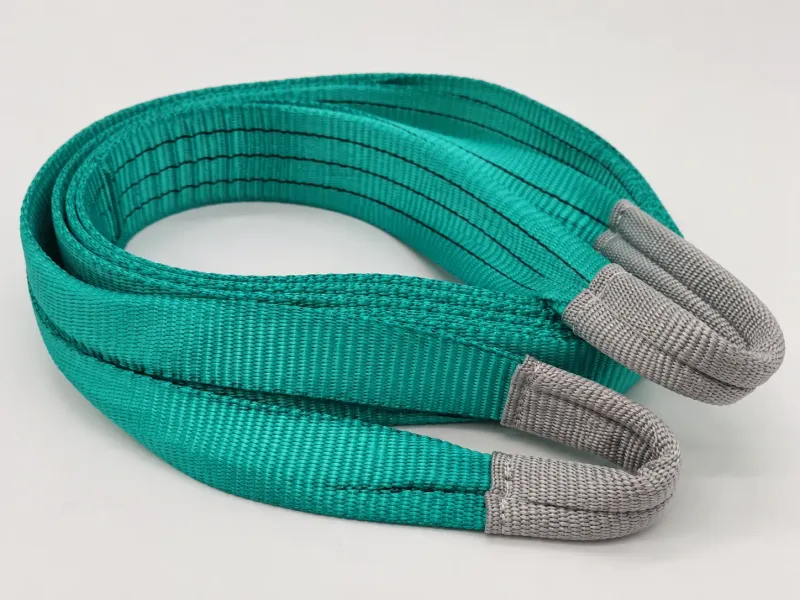
UHMWPE Lifting Sling Webbing
Ultra-high-strength UHMWPE webbing developed for lifting slings and rigging systems.
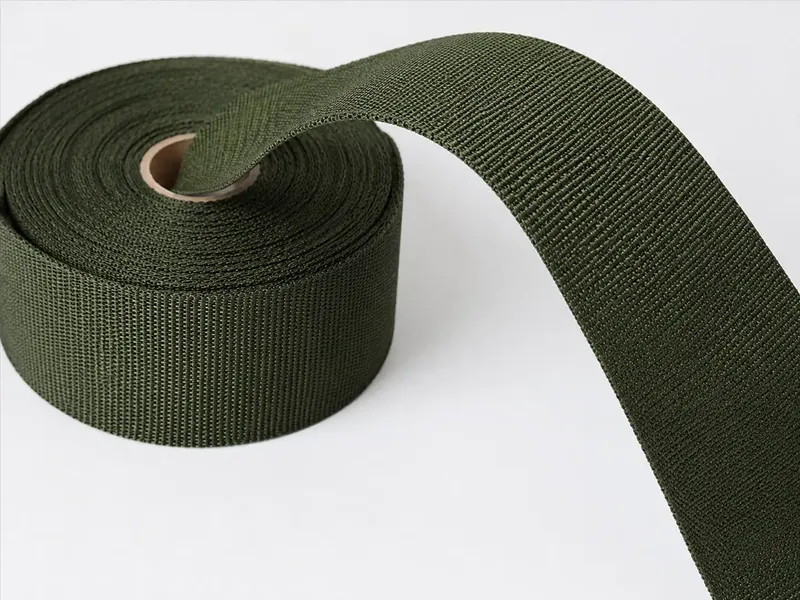
Heavy Duty Polyester Webbing
Industrial-grade polyester webbing designed for heavy-load applications and demanding outdoor environments.
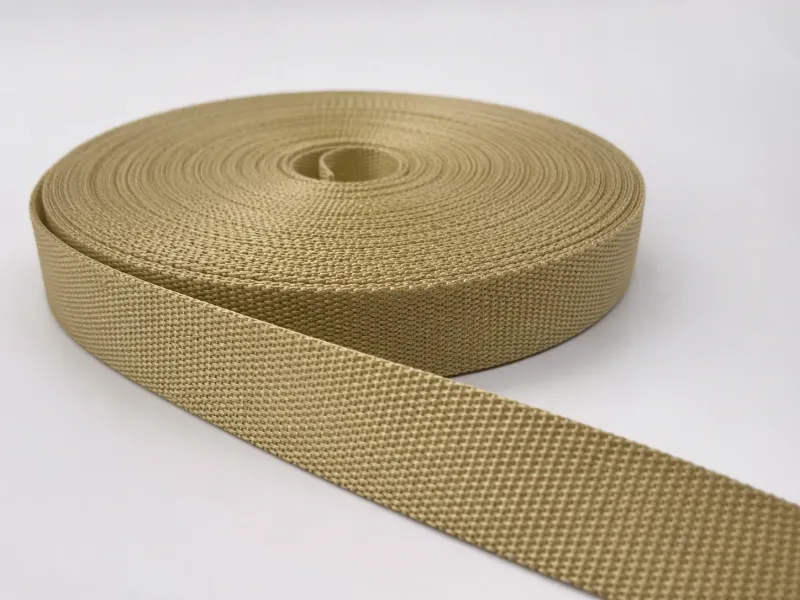
Industrial Aramid Webbing
Heavy-duty aramid webbing for industrial manufacturing, thermal protection and specialized equipment.
Related Categories
Related Applications
ASTM & ISO standard methods for measuring webbing breaking strength and elongation
Request Tensile Testing Specifications