Choosing between polyester and nylon webbing is one of the most common decisions engineers, procurement specialists, and product designers face when sourcing textile components. Both materials are synthetic, woven from polymer fibers, and available in a wide range of widths and constructions — yet they behave very differently under load, in wet environments, and under prolonged UV exposure. As of 2026, these two fiber types collectively account for the majority of industrial and consumer webbing produced globally. This guide breaks down the technical differences across all critical performance dimensions, so you can specify the right material with confidence for applications ranging from safety harnesses and seat belts to backpacks, pet leashes, and tactical gear.
Material Origins and Fiber Chemistry
What Are Polyester and Nylon Webbings Made From?
Both polyester and nylon are thermoplastic synthetic polymers, but their chemical structures produce fundamentally different performance profiles.
- Polyester webbing is woven from polyethylene terephthalate (PET) fibers. PET is a hydrophobic polymer — it repels water at the molecular level, resulting in very low moisture absorption (typically <0.4% by weight).
- Nylon webbing is woven from polyamide fibers, most commonly Nylon 6 or Nylon 6,6. Polyamide chains contain amide bonds that are mildly hygroscopic, giving nylon a moisture absorption rate of 3–8% depending on ambient humidity.
This single chemical difference — hydrophobic vs. hygroscopic — is the root cause of nearly every practical performance gap between the two materials.
Fiber Production and Weave Structure
In our production facility, both fiber types are processed on needle looms and shuttle looms capable of producing webbing widths from 10mm up to 100mm for standard grades. The weave density, yarn count, and finishing treatments applied after weaving further differentiate final product performance. High-tenacity (HT) yarn variants of both fiber types are available for load-bearing applications.
Tensile Strength and Stretch Characteristics
Strength Comparison: Polyester vs Nylon
Both materials deliver high tensile strength in industrial grades, but nylon generally exhibits a higher raw breaking strength at equivalent yarn counts, while polyester offers more consistent strength retention over time.
| Property | Polyester Webbing | Nylon Webbing |
| Typical tensile strength (HT grade, 50mm) | **2,000–10,000 lbs** | **2,000–8,000 lbs** |
| Elongation at break | 10–15% | 15–25% |
| Strength retention when wet | ~100% (minimal change) | Drops ~15–20% when saturated |
| Elastic recovery after load | Moderate | Excellent |
Stretch and Energy Absorption
Nylon's higher elongation — typically 15–25% compared to polyester's 10–15% — makes it the preferred choice for applications where shock-load absorption matters. In climbing harnesses and fall-arrest lanyards, that additional stretch dissipates kinetic energy during a fall, reducing peak force on the user. Our Heavy Duty Nylon Webbing is constructed specifically to take advantage of this property in safety-critical applications.
Conversely, for tie-down straps, seat belt webbing, and cargo restraints, low elongation is desirable — you want the strap to hold a fixed dimension under load without creeping. Polyester's more rigid response is an asset here, which is why our Seat Belt Polyester Webbing is engineered to FMVSS-compatible standards using high-tenacity PET.
Compared to polypropylene webbing at equivalent widths, both polyester and nylon deliver significantly higher tensile values — a 25mm heavy-duty polyester strap can outperform a 50mm polypropylene strap in raw breaking strength, making the fiber choice critical when space or weight is constrained.
UV Resistance, Moisture, and Environmental Performance
Outdoor and Environmental Durability
Environmental exposure is where polyester and nylon diverge most sharply for outdoor and marine applications.
UV Resistance
- Polyester has inherently good UV resistance. Untreated polyester webbing retains approximately 80–85% of its tensile strength after 1,000 hours of UV exposure in standard accelerated weathering tests (ASTM G154). UV-stabilized grades, such as our Outdoor Polyester Webbing, extend this further.
- Nylon degrades more rapidly under UV. Untreated nylon can lose 30–40% of its tensile strength after equivalent UV exposure. UV inhibitor additives improve performance but rarely close the gap entirely with polyester.
Moisture Absorption
| Condition | Polyester Webbing | Nylon Webbing |
| Moisture absorption (%) | < 0.4% | 3–8% |
| Strength when wet | No significant loss | ~15–20% strength loss |
| Drying time after submersion | Fast (minutes) | Slow (hours) |
| Dimensional stability when wet | Stable | May swell slightly |
For marine environments, polyester's near-zero water absorption is a decisive advantage. Our Outdoor Polyester Webbing is specifically formulated for applications where prolonged moisture contact is expected. Nylon's moisture uptake also causes it to stiffen when it dries after repeated wet–dry cycles, which can affect buckle fit and strap handling over time.
Temperature Performance
- Polyester retains mechanical properties up to approximately 150°C before significant softening begins.
- Nylon has a slightly higher melting point (Nylon 6,6 melts at ~265°C vs. PET at ~260°C), but in practical webbing applications operating below 100°C, the difference is negligible.
- For high-heat environments above 150°C, neither standard polyester nor nylon is adequate — that application requires aramid fiber, such as our Heat Resistant Aramid Webbing rated to 500°C.
Abrasion Resistance, Feel, and Workability
Surface Durability and Tactile Properties
Nylon has a well-established reputation for superior abrasion resistance. The polyamide molecular structure resists surface wear more effectively than PET, making nylon the standard choice for applications involving repeated sliding contact — such as dog collars, pet leashes, and tactical gear where webbing runs through metal hardware under load repeatedly.
Our Pet Nylon Webbing and Mil-Spec Nylon Webbing are both engineered to exploit this abrasion advantage. The Mil-Spec Nylon Webbing carries a tensile strength range of 3,000–10,000 lbs and is constructed to MIL-SPEC standards, where abrasion cycles through metal MOLLE hardware and load-bearing equipment are a constant performance requirement.
Surface Texture and Buckle Compatibility
- Nylon has a slightly softer, more pliable hand feel and tends to grip buckle teeth more consistently, which is valued in tactical and safety harness applications.
- Polyester has a crisper, flatter surface finish, which makes it easier to print on — especially for dye-sublimation processes. Our Sublimation Polyester Webbing takes full-color photographic-quality prints because of PET's smooth, receptive surface chemistry.
Dyeability and Color Retention
| Property | Polyester | Nylon |
| Dye uptake method | Disperse dyes at high temp | Acid dyes |
| Color fastness (wash) | Excellent | Good |
| Color fastness (UV) | Excellent | Moderate |
| Custom color feasibility | High — wide gamut | High — rich, deep tones |
Polyester's superior color fastness under UV makes it the preferred substrate for colorful outdoor products like backpack straps and luggage handles where appearance retention over years of sun exposure matters. Nylon accepts acid dyes that produce notably vibrant, deep colors — preferred in fashion and apparel applications where richness of hue outweighs long-term UV stability.
Application Selection Guide: When to Choose Each Material
Choosing the Right Webbing for Your Application
The decision between polyester and nylon webbing ultimately comes down to the dominant performance requirement of your end use. The table below summarizes the recommended choice across common applications as of 2026.
| Application | Recommended Material | Primary Reason |
| Seat belts & automotive restraints | Polyester | Low stretch, UV stable, moisture resistant |
| Safety harnesses (fall arrest) | Nylon | Energy absorption, elastic recovery |
| Dog collars & pet leashes | Nylon | Abrasion resistance, soft hand feel |
| Backpack straps & luggage | Polyester | UV resistance, color fastness, dimensional stability |
| Marine deck hardware & tie-downs | Polyester | Near-zero water absorption |
| Tactical / military gear | Nylon (MIL-SPEC) | Abrasion resistance, strength, flexibility |
| Outdoor climbing / rescue | Application-dependent | Nylon for dynamic loads; polyester for static |
| Printed / branded webbing | Polyester | Dye-sublimation compatibility |
| High-heat environments (>150°C) | Neither — use Aramid | Both polymer types degrade above 150°C |
Recommended Products by Use Case
For safety-critical load-bearing: Our Heavy Duty Polyester Webbing (tensile strength 2,000–10,000 lbs, widths 25–100mm) and Heavy Duty Nylon Webbing (tensile strength 2,000–8,000 lbs) cover the majority of industrial lifting, restraint, and safety harness applications.
For outdoor and sporting goods: Outdoor Polyester Webbing offers UV-resistant construction for gear exposed to continuous sunlight, while Tubular Nylon Webbing (widths 16–50mm) is preferred in climbing equipment for its shock-absorbing tubular construction.
For military and tactical use: Mil-Spec Nylon Webbing (tensile 3,000–10,000 lbs, MIL-SPEC construction) is the export-quality standard for load-bearing tactical equipment supplied globally to defense and law enforcement procurement teams.
For automotive seat belt applications: Both Seat Belt Polyester Webbing and Seat Belt Nylon Webbing are available in 46–50mm widths to FMVSS-compatible standards, giving OEM manufacturers flexibility to specify based on regional preference and vehicle platform requirements.
A Note on Weight
At equivalent widths and constructions, nylon webbing is typically 5–10% heavier than polyester due to higher polymer density. For weight-sensitive applications like ultralight backpacking equipment, this marginal difference can be relevant across large harness or frame systems.
Frequently Asked Questions
Is nylon or polyester webbing stronger?
In dry conditions, high-tenacity nylon and polyester webbing of equivalent construction deliver comparable tensile strength. Heavy Duty Polyester Webbing is rated at 2,000–10,000 lbs while Heavy Duty Nylon Webbing reaches 2,000–8,000 lbs across the same width range (25–100mm). However, nylon loses approximately 15–20% of its tensile strength when fully saturated with water, whereas polyester retains nearly 100% of its dry strength when wet. For wet or marine environments, polyester is therefore the stronger practical choice.
Which webbing material is better for outdoor use — polyester or nylon?
Polyester is generally preferred for outdoor applications due to its superior UV resistance and low moisture absorption. Untreated polyester retains approximately 80–85% of tensile strength after 1,000 hours of UV exposure, while untreated nylon can lose 30–40% over the same period. Polyester also dries much faster after rain or submersion. For static outdoor applications such as backpack straps, cargo tie-downs, and awning hardware, polyester is the standard industry choice as of 2026.
Why is nylon webbing used in tactical and military gear instead of polyester?
Nylon's abrasion resistance and elastic energy absorption make it the dominant choice for military and tactical webbing. When webbing is repeatedly drawn through metal MOLLE hardware, buckles, and D-rings under load, nylon's polyamide surface withstands wear cycles that would degrade polyester more rapidly. Mil-Spec Nylon Webbing (tensile strength 3,000–10,000 lbs) is manufactured to MIL-SPEC construction standards for exactly this reason. Nylon's pliability also improves buckle grip and system adjustability in the field.
Can polyester webbing be used for seat belts?
Yes. Polyester is the predominant fiber used in modern automotive seat belt webbing globally. Its low elongation (10–15%), excellent UV and color stability, minimal moisture uptake, and consistent tensile properties under repeated loading cycles make it well-suited for automotive restraint systems. Seat Belt Polyester Webbing in 46–50mm widths is produced to FMVSS-compatible standards. Nylon seat belt webbing is also available and is used in some markets and vehicle segments where its elasticity profile and tactile properties are preferred.
Does moisture affect polyester and nylon webbing differently?
Yes, significantly. Polyester absorbs less than 0.4% of its weight in moisture, retains its dimensions when wet, and dries quickly — making it stable in humid or marine environments. Nylon absorbs 3–8% moisture by weight, which causes a 15–20% reduction in tensile strength when fully saturated, slight dimensional swelling, and extended drying times. For applications involving water exposure — marine deck rigging, water sports equipment, or tropical outdoor gear — polyester is the technically correct choice unless other properties (shock absorption, abrasion resistance) override the moisture consideration.
Related Resources
Related Products (3)
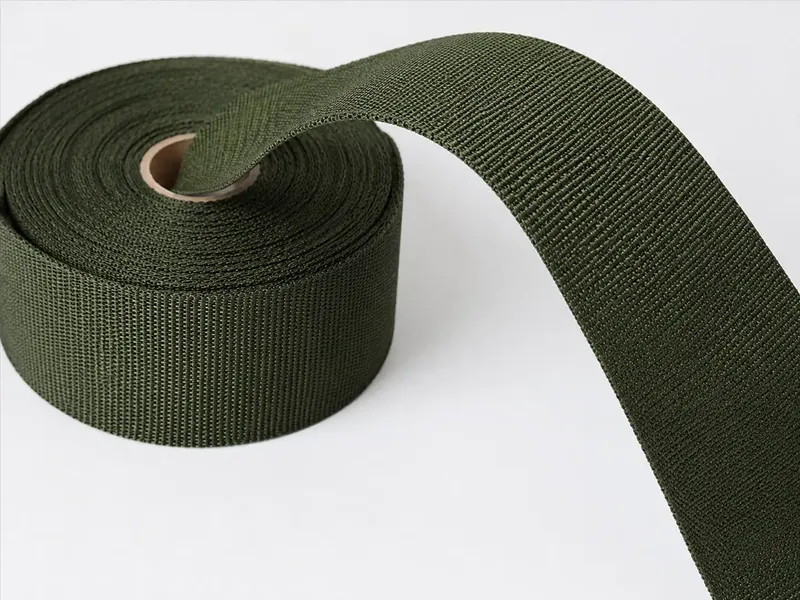
Heavy Duty Polyester Webbing
Industrial-grade polyester webbing designed for heavy-load applications and demanding outdoor environments.
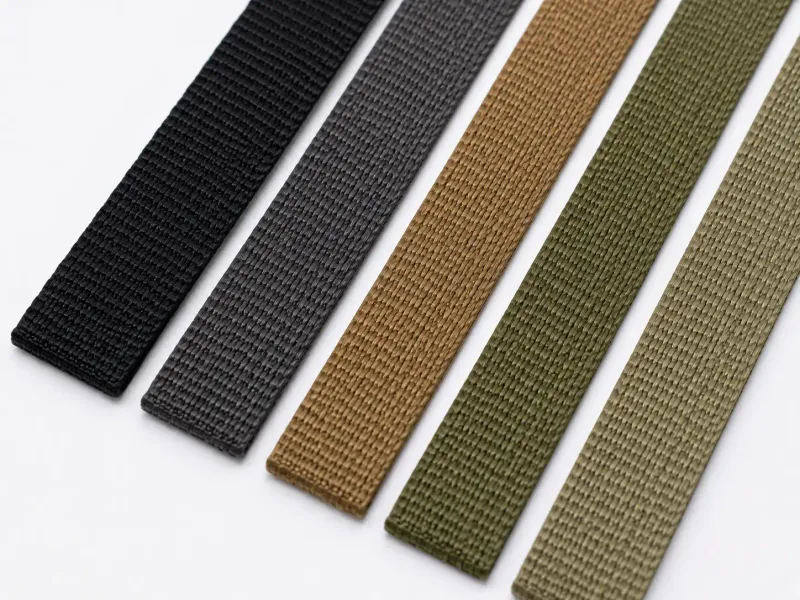
Heavy Duty Nylon Webbing
High-strength nylon webbing designed for industrial lifting, safety equipment and outdoor applications.
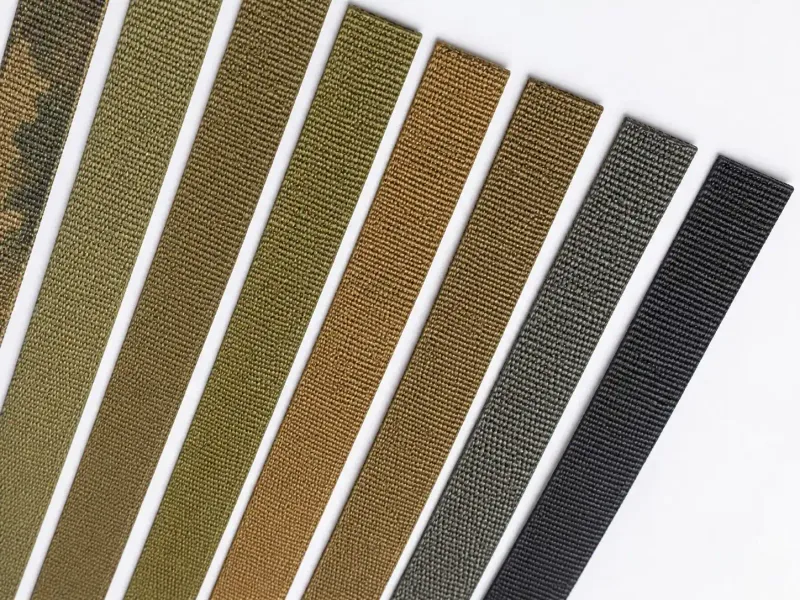
Mil-Spec Nylon Webbing
Military-grade nylon webbing engineered for tactical equipment, load-bearing systems and defense applications.
Related Categories
Related Industries
A technical comparison to help you choose the right webbing material for every application
Request a Sample or Bulk Quote Today