When a load is suspended overhead, the tensile strength certification of your nylon web strapping is not a formality — it is the primary line of defense against equipment failure and workplace injury. As of 2026, lifting and rigging standards globally require traceable, documented tensile performance for every strap used in overhead or load-bearing applications. At webbingmaker, we manufacture nylon web strapping with tensile strengths ranging from 2,000 lbs to 10,000 lbs, produced on high-tenacity nylon yarn lines and backed by in-house tensile testing. Whether you are sourcing for a rigging contractor, safety equipment OEM, or industrial distributor, this guide covers what certifications matter, how tensile ratings are determined, and how to specify the right product for your lifting application.
The Problem with Uncertified Lifting Strapping
Why Generic Webbing Fails Lifting Inspections
Not all nylon webbing is engineered for overhead lifting. Standard packaging or cargo strapping is manufactured to much lower tensile thresholds — typically 800–2,000 lbs — and lacks the traceability documentation required by occupational safety regulators in North America, Europe, and Asia-Pacific markets.
Common failure points when using uncertified strapping for lifting include:
- No documented working load limit (WLL) or rated capacity
- Yarn denier and weave density not optimized for dynamic shock loads
- No heat-setting or post-production stabilization, leading to elongation under sustained load
- Missing batch test reports, making the product non-compliant with OSHA 29 CFR 1926.251 and equivalent EN 1492-1 standards
The Compliance Gap
In rigging inspections, a strap without a legible, permanently attached capacity tag and a traceable test report is automatically flagged as non-conforming — regardless of its actual strength. Compared to certified lifting slings, uncertified alternatives expose procurement teams to liability, project delays, and mandatory equipment quarantine.
| Webbing Type | Typical Tensile Range | Certification Traceability | Suitable for Overhead Lifting? |
| Standard cargo strap | 800–2,000 lbs | None | No |
| Heavy duty nylon webbing | 2,000–8,000 lbs | Batch test report available | Yes, with documentation |
| Mil-Spec nylon webbing | 3,000–10,000 lbs | MIL-SPEC construction standard | Yes |
Every certified lifting strap we supply includes a documented tensile test report tied to its production batch.
How Tensile Strength Is Measured and Certified
Testing Methodology for Nylon Web Strapping
Tensile strength certification for lifting webbing is established through destructive break testing on a universal testing machine (UTM), following standardized protocols. The two critical values produced are:
- Break Strength (BS): The maximum load the webbing sustains before failure, measured in lbs or kN
- Working Load Limit (WLL): Typically set at 1/5 of break strength for general lifting (a 5:1 safety factor), or 1/7 for overhead critical lifts
Key Standards Referenced in 2026
- ASME B30.9 — Web slings for general industry lifting in North America
- EN 1492-1 — Flat woven webbing slings for the European market
- MIL-W-4088 / MIL-W-17337 — U.S. military-specification nylon webbing construction and performance
- WSTDA-WS-1 — Web Sling & Tie Down Association standard for synthetic web slings
Tensile Performance of Our Nylon Webbing Grades
| Product | Width Range | Tensile Strength | Construction Standard |
| Heavy Duty Nylon Webbing | 25–100mm | **2,000–8,000 lbs** | High Tenacity Nylon |
| Mil-Spec Nylon Webbing | 25–100mm | **3,000–10,000 lbs** | MIL-SPEC Construction |
Our in-house QC team tests every production batch before shipment. Test reports referencing lot numbers, break loads, and elongation at break are provided as standard documentation with export orders.
Product Specifications: Nylon Web Strapping for Lifting
Heavy Duty Nylon Webbing
Our Heavy Duty Nylon Webbing is the standard choice for industrial rigging, cargo securing, and load-bearing sling fabrication:
- Material: High tenacity nylon yarn, tightly woven flat construction
- Width: 25mm to 100mm
- Tensile Strength: 2,000 to 8,000 lbs break load depending on width and weave density
- MOQ: 500 meters per specification
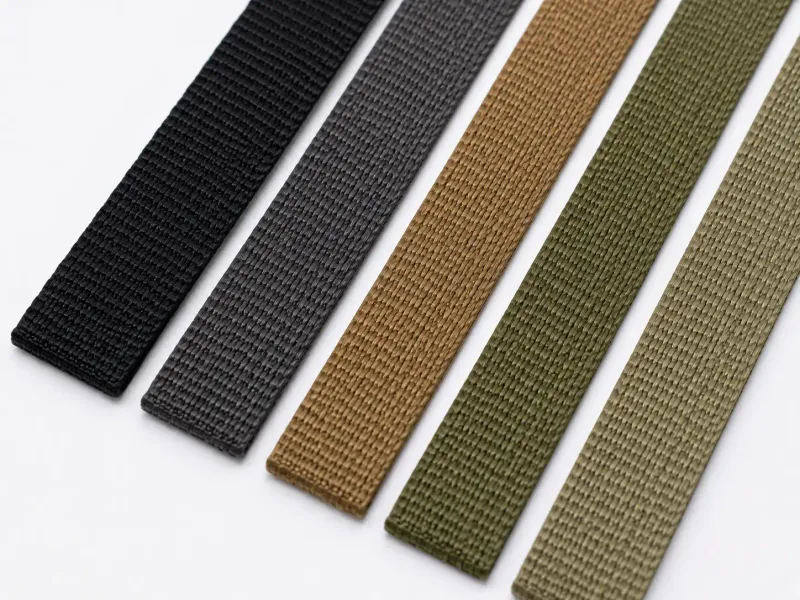
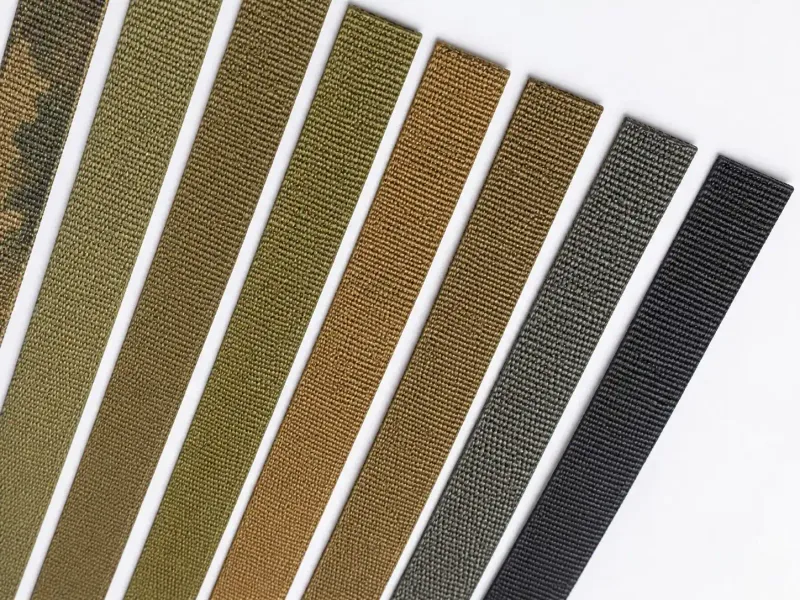
- Color options: Natural, black, and custom dyed to Pantone reference
- Post-production: Heat-set for dimensional stability under sustained load
Mil-Spec Nylon Webbing
For applications requiring the highest documented tensile performance, our Mil-Spec Nylon Webbing is manufactured to MIL-SPEC construction parameters:
- Material: High tenacity nylon, yarn count and weave per military specification
- Width: 25mm to 100mm
- Tensile Strength: 3,000 to 10,000 lbs — the upper range suitable for overhead critical lift slings
- MOQ: 500 meters per width/color
- Documentation: Full material certification and batch tensile test report included
Specification Comparison
| Specification | Heavy Duty Nylon | Mil-Spec Nylon |
| Tensile strength (max) | 8,000 lbs | **10,000 lbs** |
| MIL-SPEC construction | No | Yes |
| Width range | 25–100mm | 25–100mm |
| Batch test report | Yes | Yes |
| Custom color | Yes | Yes |
Compared to polyester webbing of equivalent width, high-tenacity nylon typically delivers 15–25% higher elongation tolerance, making it better suited for dynamic shock-load scenarios in rigging and fall arrest systems.
Lifting Application Requirements and Selection Guide
Matching Webbing Grade to Lifting Application
Selecting the correct nylon web strapping for a lifting application involves three inputs: the required working load limit, the lift geometry (straight, choker, or basket), and the regulatory standard governing the work site.
- Straight lift: WLL = break strength ÷ 5. A 50mm Heavy Duty Nylon Webbing at ~4,000 lbs BS yields a 800 lb WLL for a straight vertical lift.
- Choker hitch: Multiply straight-lift WLL by 0.75 — choker geometry reduces effective capacity.
- Basket hitch: Multiply straight-lift WLL by 2.0 when load is balanced between both legs.
Industries and Applications Served
Our certified nylon web strapping for lifting is exported to customers across the following sectors:
- Safety Protection Industry — fall arrest harness webbing and rescue sling fabrication
- Safety Harness manufacturers requiring documented WLL webbing
- Military & Tactical Industry — cargo sling and personnel lifting systems
- Outdoor Equipment Industry — rope access and vertical work positioning
Width-to-WLL Quick Reference (Straight Lift, 5:1 SF)
| Webbing Width | Approximate Break Strength | Approximate WLL (5:1 SF) |
| 25mm Heavy Duty Nylon | ~2,000 lbs | **~400 lbs** |
| 50mm Heavy Duty Nylon | ~4,500 lbs | **~900 lbs** |
| 75mm Mil-Spec Nylon | ~7,500 lbs | **~1,500 lbs** |
| 100mm Mil-Spec Nylon | ~10,000 lbs | **~2,000 lbs** |
Note: Actual WLL must be confirmed against the specific batch test report for your order. The above figures are indicative based on published product ranges.
Wholesale and Export Supply for Certified Lifting Webbing
Bulk and OEM Supply Capabilities
Webbingmaker supplies certified nylon web strapping in bulk rolls and cut-to-length formats for sling manufacturers, rigging distributors, and OEM safety equipment brands globally. As of 2026, we regularly fulfill export orders for customers in North America, Europe, the Middle East, and Southeast Asia.
What Is Included with Every Export Order
- Batch-specific tensile test report (break strength, elongation at break, lot number)
- Material data sheet confirming yarn tenacity and construction parameters
- Packing list with roll count, width, and linear meters per roll
- Optional: custom printed capacity label tape for sling finishing (min. 1,000 meters)
Ordering and MOQ
- Standard MOQ: 500 meters per width and color specification
- Custom widths within the 25–100mm range are available with sufficient lead volume
- Private label capacity tags and custom color coding available for sling fabricators
Compared to sourcing pre-finished web slings, purchasing certified webbing rolls for in-house fabrication typically reduces per-unit material cost by 30–50% at equivalent safety performance — a significant advantage for high-volume rigging contractors and sling OEMs.
We prep bulk webbing orders every week for export and our QC team checks each batch against the documented tensile specification before it ships. If you have a specific WLL requirement or regulatory standard that must be met, share it with us and we will confirm the appropriate product and documentation package.
Frequently Asked Questions
What tensile strength is required for nylon web strapping used in overhead lifting?
The required tensile (break) strength depends on your working load limit (WLL) and the applied safety factor. ASME B30.9 and EN 1492-1 both require a minimum 5:1 design factor for general overhead lifting web slings. This means a sling with a 1,000 lb WLL must have a break strength of at least 5,000 lbs. Our Mil-Spec Nylon Webbing reaches up to 10,000 lbs break strength in 100mm widths, covering WLLs up to approximately 2,000 lbs in a straight-lift configuration. For critical lifts, a 7:1 safety factor is often specified, which requires proportionally higher break strength for the same WLL.
What documentation comes with certified nylon lifting webbing?
Each export order of our Heavy Duty Nylon Webbing and Mil-Spec Nylon Webbing includes a batch tensile test report referencing the lot number, measured break strength, elongation at break, and tested width. A material data sheet confirming yarn type and construction is also included. For sling fabricators, we can supply custom capacity label tape printed with WLL, product code, and your brand identity. These documents support compliance with ASME B30.9, EN 1492-1, WSTDA-WS-1, and site-specific lifting equipment registers.
What is the difference between Heavy Duty Nylon Webbing and Mil-Spec Nylon Webbing for lifting?
Both products are manufactured from high-tenacity nylon, but Mil-Spec Nylon Webbing is produced to MIL-SPEC construction parameters — specifically yarn count, weave density, and dimensional tolerances specified in military standards such as MIL-W-4088. This results in a higher upper tensile limit (3,000–10,000 lbs vs. 2,000–8,000 lbs for Heavy Duty Nylon Webbing) and tighter batch-to-batch consistency. For civilian industrial lifting where MIL-SPEC is not contractually required, Heavy Duty Nylon Webbing is appropriate and cost-effective. For defense supply chains, fall arrest OEMs, or applications requiring MIL-SPEC traceability, Mil-Spec Nylon Webbing is the correct choice.
Can nylon web strapping be used for lifting in wet or outdoor environments?
Nylon webbing absorbs moisture, which can reduce its break strength by approximately 10–15% when fully wet compared to dry-state performance. For outdoor or marine lifting applications where prolonged water exposure is expected, this reduction must be factored into your WLL calculation. Our batch test reports reflect dry-state tensile values — specify your operating environment when requesting a quote so we can recommend the appropriate grade and conservative WLL margin. For marine lifting environments where moisture resistance is the primary concern, UHMWPE Lifting Sling Webbing (tensile strength 10,000–50,000 lbs) is an alternative worth evaluating.
What is the minimum order quantity for certified nylon lifting webbing?
The standard MOQ for both Heavy Duty Nylon Webbing and Mil-Spec Nylon Webbing is 500 meters per width and color specification. Custom widths within the 25–100mm range are available with sufficient order volume. For sling fabricators requiring custom capacity label tape or private-label documentation, the minimum for that add-on service is 1,000 meters. Sample lengths for engineering approval or regulatory submission can be arranged prior to a full production order — contact our team to discuss your qualification process.
Related Resources
Related Products (2)
Related Categories
Related Applications
Related Industries
Export-grade nylon webbing with verified tensile ratings and lifting certifications for industrial, rigging, and safety applications
Request a Quote for Certified Lifting Webbing