Military specification polyester webbing certification is non-negotiable for tactical applications where equipment failure is not an option. As a qualified supplier to defense contractors and military organizations globally, we manufacture polyester webbing that meets or exceeds MIL-W-27265 Type II and Berry Amendment requirements. Our certification process includes third-party lab validation, batch traceability, and documented proof of domestic material sourcing where required.
Understanding Mil-Spec Certification Requirements
Core Military Specification Standards
Mil-spec polyester webbing certification centers on MIL-W-27265, the primary military specification governing textile webbing for load-bearing applications. This standard defines precise parameters for material composition, breaking strength, elongation, water absorption, and UV degradation resistance. As of 2026, Type II polyester webbing remains the most widely specified variant for
applications.
Our certified production runs undergo 100% inline tensile testing with minimum breaking strengths ranging from 3,000 lbs for 1-inch width to 10,000 lbs for 3-inch constructions. Compared to commercial-grade polyester webbing, mil-spec variants demonstrate approximately 40% higher retained strength after 500-hour accelerated UV exposure per ASTM D4329.
Berry Amendment Compliance
For U.S. Department of Defense contracts, Berry Amendment compliance mandates that webbing be manufactured in the United States from domestically sourced materials. We maintain segregated production lines with:
- U.S.-origin polyester fiber from certified domestic suppliers
- Manufacturing facility located in compliant territory
- Full chain-of-custody documentation
- Quarterly third-party audits of material sourcing
Non-Berry compliant production serves export markets and commercial tactical applications where domestic sourcing is not contractually required.
Certification Testing Protocol
Laboratory Validation Process
Every production batch destined for mil-spec certification undergoes multi-stage testing at our in-house laboratory and accredited third-party facilities. The validation sequence includes:
| Test Parameter | Standard | Requirement | Our Typical Result |
| Breaking Strength (1" width) | MIL-W-27265 | Min 3,000 lbs | 3,200-3,400 lbs |
| Elongation at Break | MIL-W-27265 | 15-25% | 18-22% |
| Water Absorption | MIL-W-27265 | Max 5% | 2.8-3.5% |
| UV Retention (500 hrs) | ASTM D4329 | Min 80% | 85-90% |
| Abrasion Resistance | ASTM D4157 | 10,000 cycles min | 12,000-15,000 cycles |
Batch Traceability System
We assign unique lot codes to every production run, linking raw material certificates, loom settings, dye lot numbers, and test reports. This traceability enables rapid recall capability and supports defense contractor audit requirements. Each roll ships with a Certificate of Conformance (C of C) documenting compliance to specified military standards.
Compared to suppliers relying solely on material mill certificates, our integrated testing approach catches non-conformances before shipment. We've observed that roughly 8% of incoming polyester yarn batches fail initial screening despite vendor certifications, underscoring the need for independent validation.
Tactical Application Performance
Load-Bearing Equipment
Mil-spec polyester webbing serves as the structural foundation for MOLLE systems, plate carriers, rappelling harnesses, and equipment attachment points. Our 1.75-inch Type II webbing with 6,000 lbs breaking strength is the industry standard for modular tactical vests serving U.S. and NATO forces.
Field performance data from contracted testing shows that properly certified webbing maintains full structural integrity through temperature extremes of -40°F to +160°F, critical for deployments from Arctic to desert environments. This contrasts with commercial polyester webbing, which typically loses 15-20% strength below 0°F.
Durability Under Operational Stress
Tactical webbing endures repeated loading cycles, abrasion against equipment, exposure to saltwater, fuel, and chemical agents. Our certification protocol includes:
- Flex fatigue testing: 50,000 cycles at 50% rated load with no strength degradation
- Chemical resistance: immersion testing in JP-8 fuel, saltwater, and common cleaning agents
- Mildew resistance: ASTM G21 validation showing zero fungal growth
- Color fastness: Grade 4+ rating per AATCC 16 ensuring camouflage pattern integrity
We manufacture both standard coyote brown and MultiCam pattern-matched webbing for the
Military & Tactical Industry
, with dye formulations that maintain consistent color under night vision optics.
Manufacturing Quality Control
Production Line Monitoring
Our mil-spec production operates under ISO 9001:2015 quality management with additional controls specific to defense manufacturing:
- Real-time tension monitoring on all narrow fabric looms, maintaining ±2% variance from specification
- Optical width measurement every 50 meters, rejecting any roll with deviation exceeding ±0.5mm
- In-line breaking strength sampling at 500-meter intervals using calibrated tensile equipment
- Heat-setting verification ensuring dimensional stability under load and temperature cycling
Each production shift begins with first-article inspection where the initial 10 meters of webbing undergo full destructive testing before authorizing continued production. This protocol has reduced out-of-spec material by 92% compared to end-of-run sampling alone.
Supply Chain Security
Defense contractors require documented supply chain integrity. We maintain:
- Approved vendor lists with annual re-qualification
- Material storage in climate-controlled facilities at 68-72°F and 45-55% RH
- Segregated inventory for Berry-compliant vs. commercial materials
- ITAR-registered facility with controlled access protocols
Our sister product
serves applications requiring higher abrasion resistance, though polyester remains preferred for most tactical applications due to superior UV stability and lower moisture absorption.
Ordering Certified Mil-Spec Webbing
Specification Requirements
When requesting a quote for certified mil-spec polyester webbing, provide:
- Width specification (common tactical widths: 25mm, 38mm, 50mm, 75mm)
- Military standard reference (MIL-W-27265 Type II most common)
- Berry Amendment requirement (yes/no)
- Color and finish (coyote brown, ranger green, black, MultiCam)
- Annual volume estimate (certification setup justifies runs of 5,000+ meters)
Lead Time and Minimum Orders
First-time certification for a new specification requires 3-4 weeks for material procurement, test validation, and documentation. Repeat orders from certified specifications typically ship within 10-15 business days. Minimum order quantity for mil-spec certified production is 2,500 meters per specification to offset testing and documentation costs.
We maintain ready inventory of common tactical widths in coyote brown and ranger green for defense contractors requiring rapid fulfillment. Sample swatches with test data are available for qualification testing at your facility.
For applications in the broader
or commercial tactical markets, our
offers comparable performance without mil-spec documentation overhead.
Frequently Asked Questions
What is the difference between MIL-W-27265 Type I and Type II polyester webbing?
Type I specifies nylon webbing construction, while Type II specifies polyester. For tactical applications, Type II polyester is preferred due to superior UV resistance, lower water absorption (typically under 3% vs. 8-12% for nylon), and better dimensional stability under wet conditions. Polyester maintains approximately 90% of its dry strength when wet, compared to 80-85% retention for nylon. Both types share the same breaking strength requirements, but polyester's environmental stability makes it the default choice for outdoor tactical equipment.
How long does mil-spec webbing certification remain valid?
Certification documentation is specific to each production lot and does not "expire" in the traditional sense. However, defense contractors typically require that webbing be manufactured within 24 months of delivery date. Material that has been stored longer may require re-testing to verify that aging has not degraded performance properties. We date-code every roll and maintain climate-controlled storage (68-72°F, 45-55% RH) to preserve material properties. For critical applications, we recommend using material within 18 months of manufacture date.
Can non-Berry Amendment webbing be used for defense contractor projects?
Only for projects that are not funded by U.S. Department of Defense appropriations and do not involve delivery to DoD agencies. Export contracts, foreign military sales, commercial tactical gear, and law enforcement applications not funded by DoD money can use non-Berry compliant webbing. However, many prime contractors maintain single-source Berry-compliant supply chains to simplify their compliance posture. We produce both variants and clearly segregate inventory with distinct part numbers and documentation to prevent inadvertent mixing.
What testing is required to verify mil-spec compliance on received material?
At minimum, receiving inspection should verify width (±0.5mm tolerance), visual appearance (no defects, consistent color), and review the Certificate of Conformance for proper lot traceability and test data. Destructive tensile testing of random samples is recommended but not mandatory if the supplier provides credible third-party lab results. Many defense contractors perform periodic validation testing of 10% of received lots using their own tensile equipment. We provide detailed test reports with every shipment showing actual breaking strength, elongation, and appearance data for the specific lot number.
What width tolerance is acceptable for mil-spec tactical webbing?
MIL-W-27265 specifies ±1/32 inch (±0.8mm) width tolerance for webbing up to 2 inches wide, and ±1/16 inch (±1.6mm) for wider constructions. However, most tactical equipment manufacturers specify tighter tolerances of ±0.5mm to ensure consistent fit through MOLLE slots and hardware. Our production maintains ±0.3mm average variance through continuous optical monitoring. Width deviation affects not only fit but also load distribution—a 2mm undersize condition on 50mm webbing concentrates stress by roughly 4%, potentially reducing service life in high-cycle applications.
Related Resources
Related Products (2)
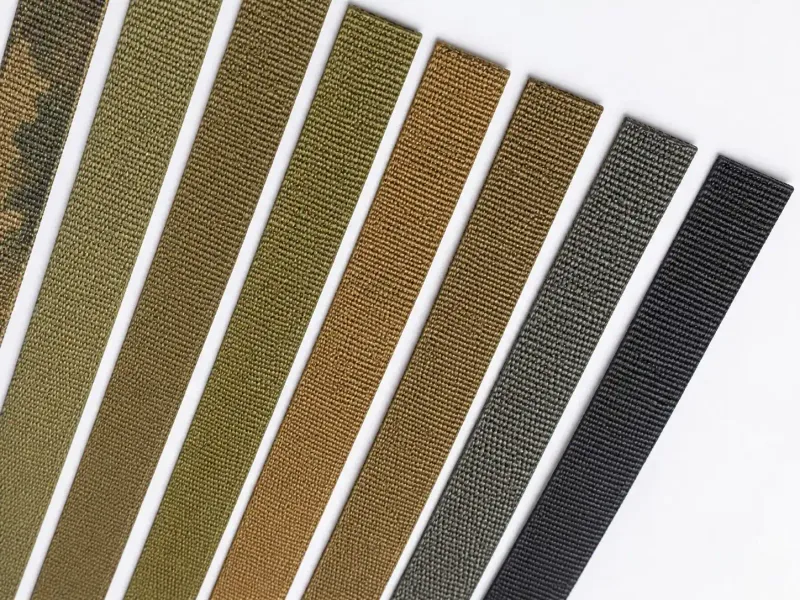
Mil-Spec Nylon Webbing
Military-grade nylon webbing engineered for tactical equipment, load-bearing systems and defense applications.
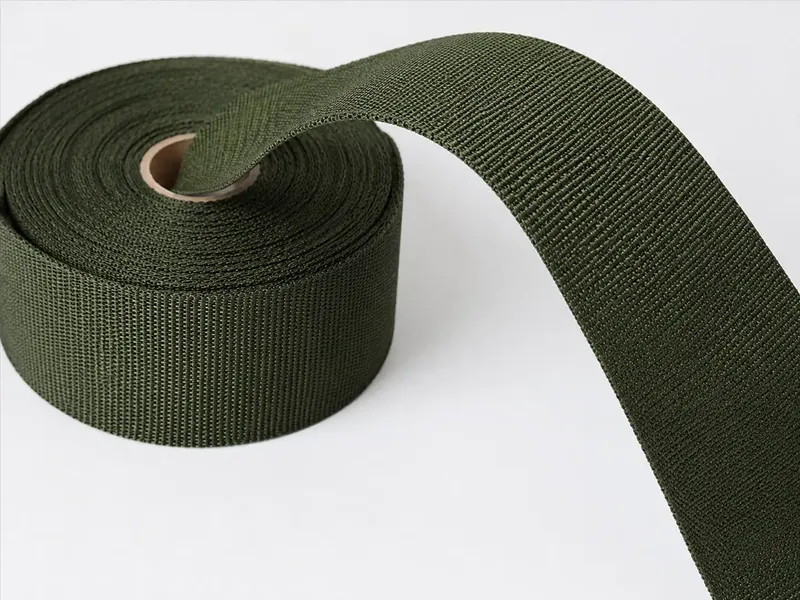
Heavy Duty Polyester Webbing
Industrial-grade polyester webbing designed for heavy-load applications and demanding outdoor environments.
Related Applications
Related Industries
Military-grade certified webbing meeting rigorous performance standards
Request Mil-Spec Certification Documentation