Selecting an industrial webbing belt for high temperature environments is not a decision to make by instinct. The wrong material will degrade, lose tensile strength, or fail entirely within weeks of deployment — creating safety hazards and costly downtime. As of 2026, the current industry standard demands that engineers and procurement teams evaluate operating temperature range, continuous versus peak exposure, chemical compatibility, and load-bearing requirements before specifying any webbing product. This guide walks through each critical selection factor, compares the leading high-temperature webbing materials available from webbingmaker, and provides a practical framework for matching the right product to your application — whether you are sourcing for foundry operations, safety harness assemblies, automotive manufacturing lines, or military and industrial lifting systems.
Why Standard Webbing Fails in High Temperature Environments
The Core Problem with Conventional Webbing Materials
Most off-the-shelf webbing — polypropylene, standard polyester, and even nylon — is engineered for ambient or mildly elevated temperatures. When procurement teams substitute these materials into high-heat applications, the consequences follow a predictable pattern:
- Polypropylene webbing begins to soften at approximately 80°C and loses structural integrity above 100°C. It is entirely unsuitable for thermal environments.
- Standard polyester webbing retains reasonable strength up to about 150°C under continuous load, but prolonged exposure above that threshold causes accelerated fiber degradation.
- Nylon webbing performs better — sustaining use up to roughly 160°C — but moisture absorption at elevated temperatures further reduces its effective tensile rating.
Comparison: Ambient vs. High-Temperature Performance
| Material | Continuous Service Temp | Short-Term Peak Temp | Suitable for >200°C? |
| Polypropylene | ~80°C | ~100°C | No |
| Polyester | ~150°C | ~170°C | No |
| Nylon | ~160°C | ~180°C | No |
| Para-Aramid (Kevlar-type) | ~300°C | ~500°C | Yes |
Compared to standard polyester webbing, aramid fiber webbing maintains over 90% of its room-temperature tensile strength at 300°C — a performance gap that cannot be bridged by design workarounds. For any environment exceeding 180°C, aramid is the engineering-correct choice, not an upgrade option.
Key Selection Criteria for High-Temperature Industrial Webbing
Step-by-Step Selection Framework
Before specifying any webbing product for a thermal application, work through these five criteria in order:
1. Establish Your Temperature Envelope
Differentiate between continuous operating temperature and peak/excursion temperature. A foundry conveyor may operate at 250°C continuously but encounter radiant spikes to 450°C during pours. A webbing rated only to 300°C continuous may be adequate or insufficient depending on dwell time at peak. The Industrial Aramid Webbing from webbingmaker is rated -50°C to 500°C, covering virtually all industrial thermal applications in a single specification.
2. Define Load and Width Requirements
- Identify the working load limit (WLL) and required safety factor (typically 5:1 for personnel-critical applications, 4:1 for general industrial lifting).
- Match width to hardware compatibility. Aramid products are available in widths from 20mm to 150mm, accommodating everything from narrow harness loops to wide conveyor belts.
- For safety harness applications specifically, standard harness webbing widths of 45–50mm align with EN/ANSI harness hardware.
3. Assess Chemical and Flame Exposure
High-temperature environments frequently involve chemical exposure — oils, acids, hydraulic fluids, or process gases. Key properties to verify:
- LOI (Limiting Oxygen Index): For flame-retardant specification, the Flame Retardant Aramid Webbing carries an LOI above 28%, meaning it will not sustain combustion in normal oxygen concentrations.
- Cut resistance: In metal fabrication or glass handling environments, Cut Resistant Aramid Webbing adds para-aramid cut protection alongside thermal resistance.
4. Evaluate Construction and Weave Type
- Flat woven webbing distributes load evenly and is preferred for lifting slings and conveyor applications.
- For MIL-SPEC or defense procurement, Military Aramid Webbing is built to MIL-SPEC construction in widths of 20–75mm, verified against military-grade performance standards.
5. Confirm MOQ and Bulk Supply Capability
High-temperature webbing is a specialty product. Confirm that your supplier can fulfill ongoing production volumes — not just sample quantities. Webbingmaker supplies aramid webbing for export-grade wholesale orders globally, serving North America, Europe, and industrial markets across Asia.
Aramid Webbing: The Primary Material for High Temperature Applications
Why Para-Aramid Fiber Dominates Thermal Webbing Specifications
Aramid fiber — particularly para-aramid — has been the material of choice for high-temperature industrial webbing since the 1980s. Its thermal stability is a function of the aromatic polyamide molecular structure, which resists decomposition at temperatures where conventional polymer fibers have already melted.
Aramid Webbing Product Overview
| Product | Material | Width Range | Temperature Rating | Primary Use Case |
| [Industrial Aramid Webbing](/products/industrial-aramid-webbing/) | Industrial Aramid Fiber | 20–150mm | -50°C to 500°C | General industrial, conveyor, lifting |
| [Heat Resistant Aramid Webbing](/products/heat-resistant-aramid-webbing/) | Para-Aramid Fiber | 20–100mm | Up to 500°C | Thermal insulation straps, furnace applications |
| [Aramid Safety Harness Webbing](/products/aramid-safety-harness-webbing/) | Aramid Fiber | 45–50mm | Up to 500°C | Fall protection in hot environments |
| [Flame Retardant Aramid Webbing](/products/flame-retardant-aramid-webbing/) | Flame Resistant Aramid | 25–75mm | High temp + LOI >28% | Welding, foundry, petrochemical |
| [Cut Resistant Aramid Webbing](/products/cut-resistant-aramid-webbing/) | Para-Aramid | 20–100mm | High temp + cut resistance | Metal fabrication, glass handling |
| [Military Aramid Webbing](/products/military-aramid-webbing/) | Military Grade Aramid | 20–75mm | MIL-SPEC | Defense, tactical, aerospace |
Key Performance Properties (as of 2026)
- Thermal stability: Para-aramid retains structural integrity at temperatures up to 500°C — approximately 3× the service temperature of standard polyester.
- Tensile strength: Aramid fibers deliver high strength-to-weight ratios suitable for load-bearing applications without adding bulk.
- Flame resistance: Aramid does not melt; it chars. This behavior is critical in fire-adjacent environments because a charred webbing retains partial load capacity, whereas a melted polypropylene webbing fails instantly.
- Chemical resistance: Resistant to most organic solvents and hydraulic fluids; less resistant to strong acids and alkalis, so confirm compatibility for specific process environments.
For safety harness applications in welding, steel mills, or petrochemical plants, Aramid Safety Harness Webbing is the engineered solution — compared to standard nylon harness webbing, it provides roughly 3× greater temperature resistance without increasing harness bulk.
Application-Specific Recommendations by Industry
Matching Webbing to Your Industry and Use Case
Different thermal applications impose different combinations of load, temperature, and chemical exposure. Use this section to cross-reference your industry with the appropriate webbing specification.
Automotive Manufacturing
Automotive assembly lines — particularly paint oven conveyors, body-in-white handling, and powertrain assembly — frequently operate at 180–220°C. Industrial Aramid Webbing in widths of 50–100mm is the standard specification for conveyor and strap applications in these environments. Compared to standard polyester straps, aramid webbing in paint oven conveyors typically extends replacement intervals by a factor of 4–6×, reducing maintenance downtime.
Safety Harness and Fall Protection
Workers in foundries, steel mills, and petrochemical plants require fall protection harnesses rated for thermal exposure. Aramid Safety Harness Webbing at 45–50mm width meets the dimensional requirements of standard harness hardware while providing heat resistance up to 500°C. This is a non-negotiable specification for any Safety Harness deployed near open flames or radiant heat sources.
Military and Tactical Applications
Defense and aerospace applications often combine thermal exposure with MIL-SPEC load requirements. Military Aramid Webbing is built to MIL-SPEC construction in 20–75mm widths, suitable for vehicle recovery straps, aircraft tie-down, and tactical equipment used in high-heat operational theaters. The Military & Tactical Industry consistently specifies aramid over nylon for any application where temperature excursions above 200°C are possible.
Industrial Lifting and Rigging
For lifting slings and rigging in hot environments, select aramid webbing with a verified breaking strength appropriate to the required safety factor. Specify Industrial Aramid Webbing in the 100–150mm width range for wide-body sling applications. Always confirm that the hardware (hooks, rings, shackles) is also rated for the thermal environment — a 500°C-rated webbing is only as safe as its weakest attached component.
Flame and Spark Environments (Welding, Foundry)
In welding stations and foundry operations, the combination of molten metal spatter and sustained radiant heat requires webbing with both thermal resistance and a high LOI. Flame Retardant Aramid Webbing with LOI above 28% is the appropriate specification. Standard flame-retardant treated polyester webbing — while cheaper — will not sustain its FR treatment beyond 100–150 wash or heat cycles, whereas aramid's flame resistance is inherent to the fiber structure and does not wash out.
Common Specification Mistakes and How to Avoid Them
Mistakes That Lead to Premature Webbing Failure
After evaluating numerous high-temperature webbing failures in the field, the same specification errors appear repeatedly. Avoid these:
Mistake 1: Specifying for Ambient Temperature Only
Engineers sometimes specify webbing based on the ambient room temperature of the facility rather than the actual temperature at the webbing contact point. A conveyor running through a 250°C oven still has webbing contacting surfaces at 250°C, regardless of the 22°C factory floor temperature.
Solution: Always measure or calculate the temperature at the webbing contact zone, not the ambient space temperature.
Mistake 2: Ignoring Peak vs. Continuous Temperature
- Continuous service temperature = the temperature the webbing sustains indefinitely without strength loss.
- Peak/excursion temperature = short-duration spikes the webbing must survive without immediate failure.
Specify a webbing whose continuous service rating covers your peak excursion, not just your average operating temperature. For environments with 500°C spikes, Heat Resistant Aramid Webbing rated to 500°C provides the necessary safety margin.
Mistake 3: Over-Relying on FR Coatings
Some buyers select standard webbing with a flame-retardant coating to reduce cost. As noted above, applied FR treatments degrade with heat cycling. Aramid's LOI above 28% is a fiber-level property — it does not wash off, abrade away, or degrade with repeated heat exposure.
Mistake 4: Ignoring Width-Load Compatibility
| Width | Typical WLL Range | Recommended Application |
| 20–30mm | Light duty restraint | Strap lashing, small component handling |
| 45–50mm | Harness-grade | Personal fall protection, safety harness |
| 75–100mm | Medium lifting | Industrial slings, conveyor sections |
| 100–150mm | Heavy lifting | Wide-body slings, bulk material handling |
Always cross-reference the webbing width against the required WLL and hardware compatibility before ordering.
Mistake 5: Underestimating MOQ Planning for Specialty Materials
Aramid webbing is a specialty fiber product. Unlike commodity polyester, supply lead times and MOQs differ. Plan procurement cycles accordingly, especially for export orders destined for North American or European manufacturing facilities.
Frequently Asked Questions
What is the best webbing material for temperatures above 300°C?
Para-aramid fiber is the correct material choice for sustained exposure above 300°C. Products such as Industrial Aramid Webbing and Heat Resistant Aramid Webbing are rated for continuous service up to 500°C. No standard synthetic fiber — polyester, nylon, or polypropylene — is suitable above 180°C under load. For environments with flame or spark exposure, specify Flame Retardant Aramid Webbing, which carries an LOI above 28%, meaning it will not sustain combustion in normal atmospheric conditions.
Can I use nylon or polyester webbing in a high temperature environment if I coat it with a flame retardant?
FR-coated polyester or nylon webbing is not recommended for sustained high-temperature applications. Applied flame retardant treatments degrade with repeated heat cycling — typically within 100–150 thermal cycles — and the base fiber's tensile properties still deteriorate above 160°C regardless of the coating. For any application above 180°C, aramid webbing with inherent thermal resistance is the engineering-correct specification. FR coatings are appropriate only for ambient-temperature applications requiring incidental flame protection, not for environments with continuous or recurring thermal exposure.
What width of aramid webbing should I specify for a safety harness used in a foundry?
For personal fall protection harnesses, the standard webbing width is 45–50mm, which matches the hardware dimensions of EN 361 and ANSI Z359-compliant harness hardware. Aramid Safety Harness Webbing is available in exactly this 45–50mm range with temperature resistance up to 500°C. Always verify that all harness hardware (buckles, D-rings, connectors) is also rated for the thermal environment, as the webbing's temperature resistance does not compensate for hardware failure.
How does aramid webbing compare to UHMWPE webbing for high temperature applications?
UHMWPE (Ultra-High Molecular Weight Polyethylene) webbing offers exceptional tensile strength — products like UHMWPE Lifting Sling Webbing are rated at 10,000–50,000 lbs — and excellent chemical resistance, making it ideal for marine, lifting, and tactical applications at ambient temperatures. However, UHMWPE has a service temperature ceiling of approximately 80–100°C, significantly lower than aramid. For any application above 150°C, aramid is the correct choice. UHMWPE should not be specified for thermal environments regardless of its tensile performance.
Is cut-resistant aramid webbing also heat resistant?
Yes. Cut Resistant Aramid Webbing is constructed from para-aramid fiber, which provides both high cut resistance and thermal resistance inherent to the aramid material class. This makes it well-suited for metal fabrication, glass handling, and other environments that combine mechanical hazards with elevated temperatures. It is available in widths from 20–100mm. For applications where the primary hazard is flame or extreme radiant heat rather than cutting, Flame Retardant Aramid Webbing or Heat Resistant Aramid Webbing may be the more targeted specification.
Related Resources
Related Products (3)
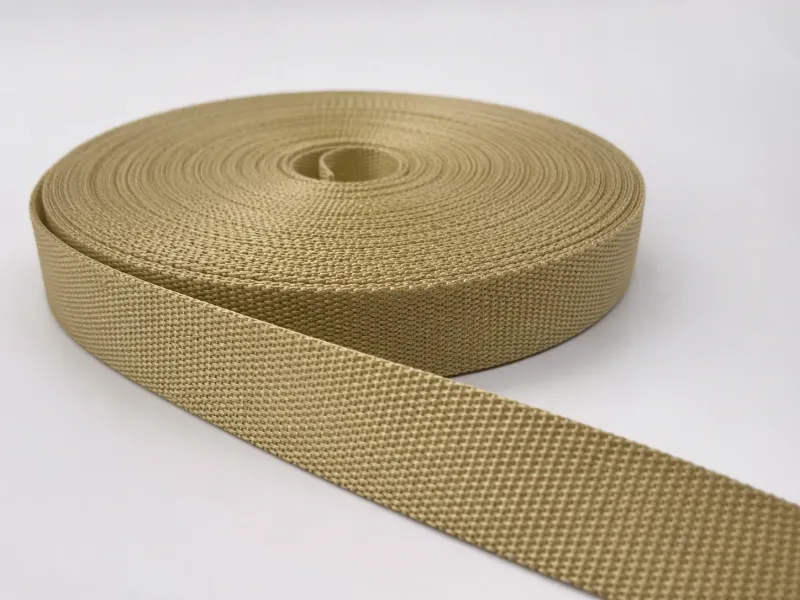
Industrial Aramid Webbing
Heavy-duty aramid webbing for industrial manufacturing, thermal protection and specialized equipment.
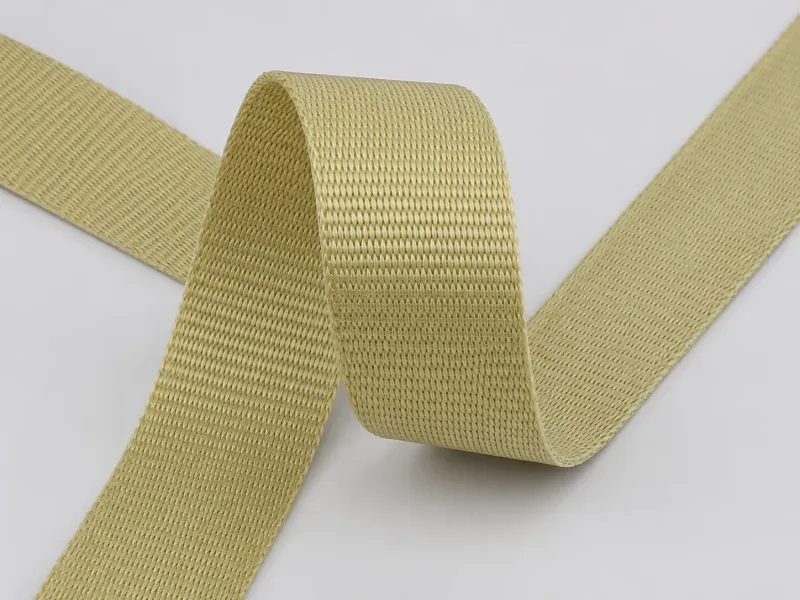
Heat Resistant Aramid Webbing
High-temperature aramid webbing engineered for thermal protection and industrial safety applications.
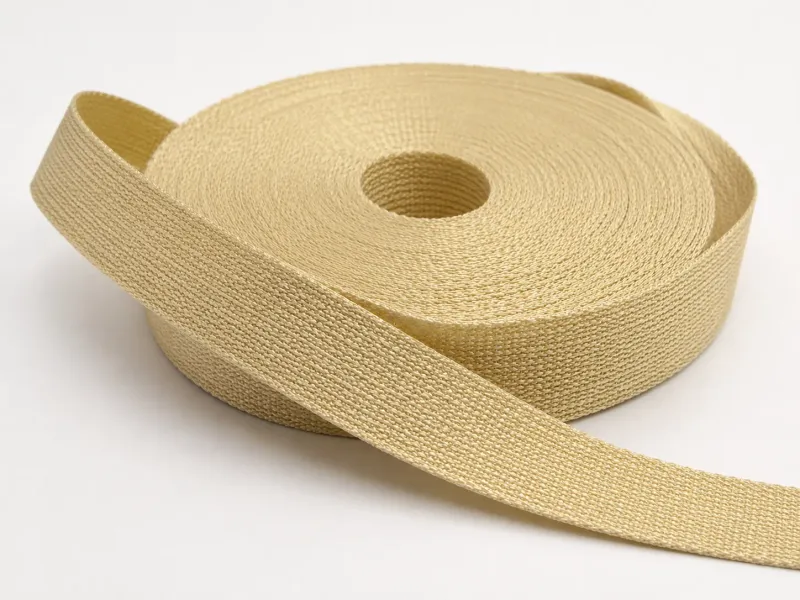
Flame Retardant Aramid Webbing
Flame-retardant aramid webbing designed for protective equipment and fire safety applications.
Related Categories
Related Applications
Related Industries
A practical guide to choosing the right heat-resistant webbing for demanding industrial applications
Request a High-Temperature Webbing Sample or Quote