Selecting industrial webbing with inadequate tensile strength can lead to catastrophic failure in load-bearing applications. As of 2026, industrial webbing materials range from 800 lbs for light-duty polypropylene to over 50,000 lbs for ultra-high molecular weight polyethylene (UHMWPE) constructions. Understanding what tensile strength to expect from industrial webbing belt products requires examining material composition, width, construction method, and intended application. This guide provides concrete specifications across our production range to help engineers and procurement specialists make data-driven material selections.
Tensile Strength by Material Type
Material-Specific Breaking Strength Ranges
Industrial webbing tensile strength varies dramatically by base material. We manufacture webbing across five primary material families, each delivering distinct strength-to-weight profiles:
| Material | Typical Width Range | Tensile Strength Range | Strength-to-Weight |
| Polypropylene | 15-100mm | 800-5,000 lbs | Moderate |
| Polyester | 10-100mm | 2,000-10,000 lbs | High |
| Nylon | 10-100mm | 2,000-10,000 lbs | High |
| UHMWPE | 10-150mm | 10,000-50,000 lbs | Exceptional |
| Aramid | 20-150mm | 5,000-30,000 lbs | Exceptional |
Polypropylene Webbing Strength
Our Heavy Duty Polypropylene Webbing delivers 800-5,000 lbs breaking strength depending on width and denier. A 50mm width typically achieves 2,400 lbs tensile strength. Compared to polyester equivalents, polypropylene offers roughly 40% lower strength but superior chemical resistance and near-zero water absorption—critical for Marine Industry applications. We verify each production batch with universal testing machines calibrated to ISO 13934-1 standards.
Polyester and Nylon Strength Profiles
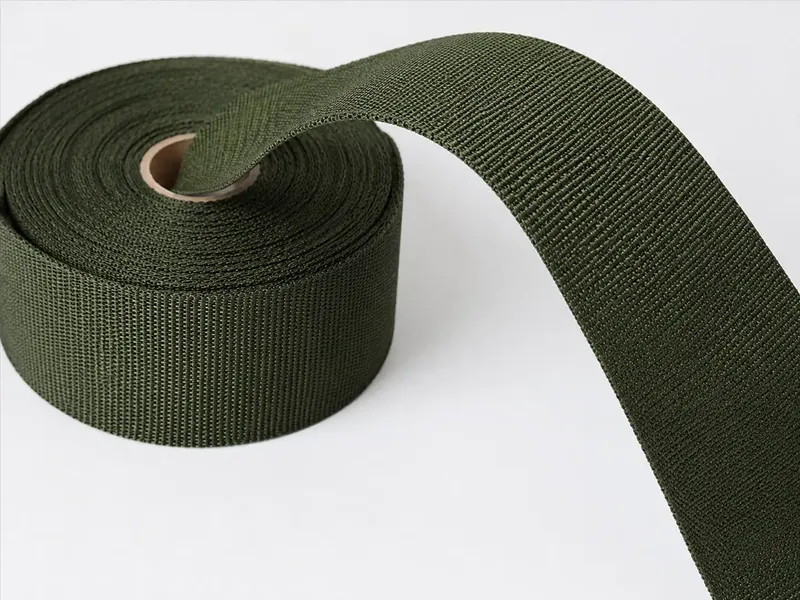
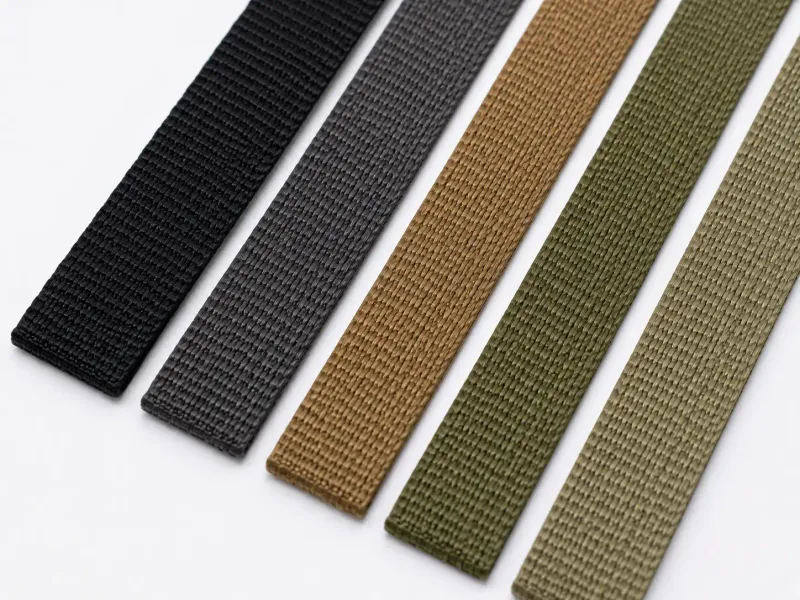
Heavy Duty Polyester Webbing and Heavy Duty Nylon Webbing occupy the mid-strength category with 2,000-10,000 lbs capacity. Key differences:
- Polyester: Lower stretch (3-5% at break), superior UV resistance, maintains 85% strength after 2,000 hours accelerated weathering
- Nylon: Higher elongation (15-20% at break), better abrasion resistance, absorbs 3-5% water weight affecting dimensional stability
- Mil-Spec Nylon Webbing: Military-grade construction achieving 3,000-10,000 lbs with Berry Amendment compliance for defense contracts
We produce both materials in widths from 25-100mm. A 50mm polyester belt typically rates at 5,500 lbs, while equivalent nylon achieves 5,800 lbs due to higher fiber tenacity.
High-Performance Materials: UHMWPE and Aramid
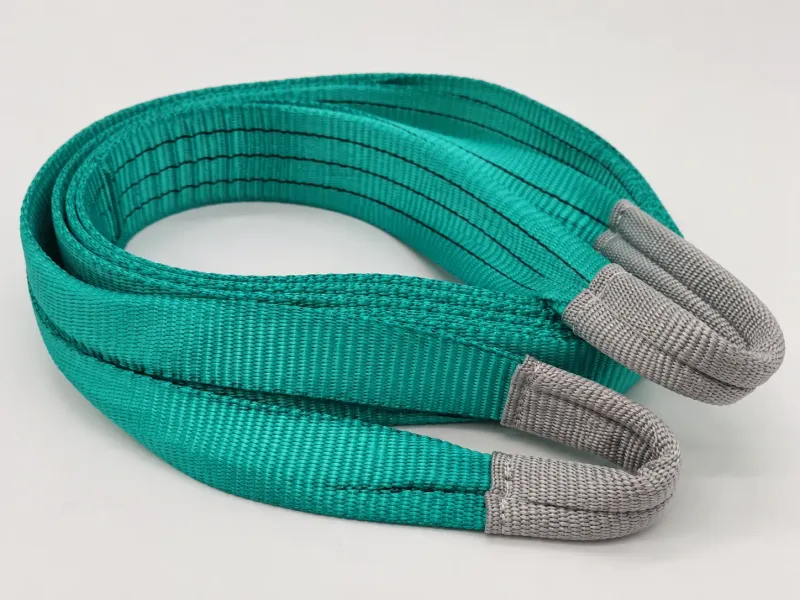
UHMWPE Lifting Sling Webbing represents the upper strength tier with 10,000-50,000 lbs breaking strength. A 75mm UHMWPE belt achieves 28,000 lbs at just 60% the weight of equivalent polyester. This 15:1 strength-to-weight ratio makes UHMWPE ideal for aerospace and advanced rigging where weight reduction directly impacts system performance.
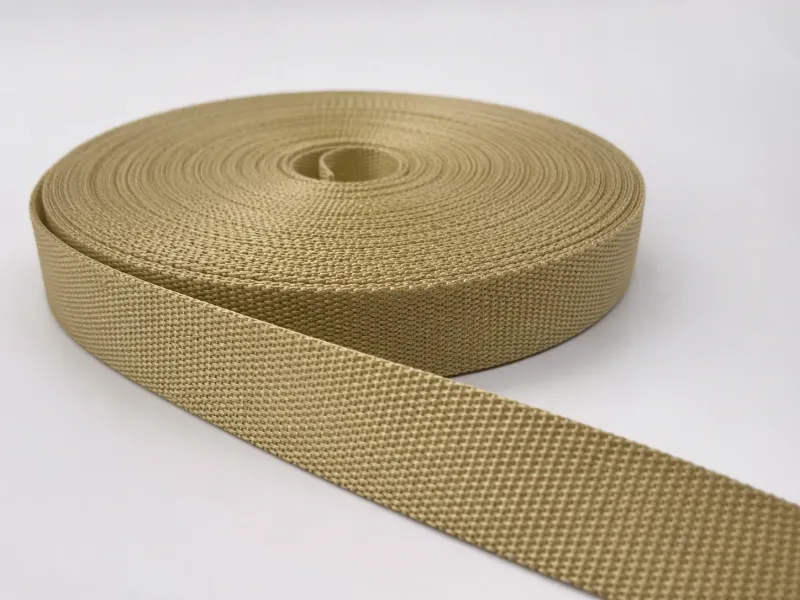
Industrial Aramid Webbing operates in the 5,000-30,000 lbs range with exceptional heat resistance (maintains structural integrity to 500°C). Unlike UHMWPE which degrades above 150°C, aramid serves high-temperature applications in Safety Protection Industry and industrial furnace equipment.
Width and Construction Impact on Load Capacity
How Width Affects Tensile Strength
Tensile strength scales proportionally with webbing width, but construction method introduces variables. We manufacture widths from 10mm to 300mm across different loom types:
| Width (mm) | Polyester Strength | Nylon Strength | UHMWPE Strength |
| 25mm | 2,200 lbs | 2,400 lbs | 12,000 lbs |
| 50mm | 5,500 lbs | 5,800 lbs | 28,000 lbs |
| 75mm | 8,200 lbs | 8,600 lbs | 42,000 lbs |
| 100mm | 10,000 lbs | 10,000 lbs | 50,000 lbs |
These figures represent our standard constructions tested per ASTM D6775. Custom denier specifications can increase these values by 15-25% at equivalent widths.
Flat vs. Tubular Construction
Tubular Nylon Webbing and tubular constructions generally deliver 10-15% higher tensile strength than flat weaves at identical width and material specs. The tubular structure distributes load more evenly across yarn paths. However, flat weaves offer better dimensional stability under sustained loads—critical for Seat Belt applications where creep must remain below 2% over the product lifetime.
We run both constructions through our quality control protocol including:
- Break strength testing: 3 samples per 10,000-meter production run
- Elongation measurement: Verified at 50% and 100% of rated load
- Dimensional stability: Width tolerance maintained at ±0.5mm
- Creep testing: 168-hour sustained load at 30% breaking strength for critical applications
Application-Specific Strength Requirements
Safety Factor and Working Load Limits
Understanding what tensile strength to expect from industrial webbing belt products requires calculating working load limits (WLL) using appropriate safety factors. Industry standards vary by application:
| Application Category | Typical Safety Factor | Example: 5,000 lb Belt WLL |
| General cargo strapping | 3:1 | 1,667 lbs |
| Fall protection / Safety Harness | 5:1 | 1,000 lbs |
| Lifting slings | 5:1 to 7:1 | 714-1,000 lbs |
| Climbing Equipment | 10:1 | 500 lbs |
| Automotive restraints | Per FMVSS 209/210 | Regulatory specific |
For Tactical Gear and Military & Tactical Industry applications, we manufacture Mil-Spec Nylon Webbing meeting MIL-W-27265 with verified 6,000 lbs minimum break strength on 50mm widths. Defense contractors specify 5:1 minimum safety factors for load-bearing components.
Material Selection by Industry
Our customer base across multiple industries consistently selects materials based on these strength-application pairings:
- Automotive Industry: Seat Belt Polyester Webbing at 7,000 lbs (50mm) for FMVSS compliance, maintaining 90% strength after 50,000 abrasion cycles
- Marine Industry: Marine Polypropylene Webbing at 2,800 lbs (50mm) chosen for chemical resistance despite lower strength; saltwater applications prioritize corrosion immunity
- Outdoor Equipment Industry: Heavy Duty UHMWPE Webbing at 28,000 lbs (50mm) for ultralight backpacking gear where every gram matters
- Safety Protection Industry: Aramid Safety Harness Webbing rated 8,500 lbs (45mm) for high-temperature industrial environments where polyester would degrade
We prep bulk orders from 1,000 meters minimum with full material certifications. Custom testing protocols available for specialized compliance requirements.
Testing Standards and Verification Methods
Laboratory Testing Protocols
Our in-house testing lab performs tensile verification on every production batch using Instron universal testing machines with ±1% accuracy at loads up to 50,000 lbs. Standard test procedure:
- Sample preparation: Three specimens cut from different points in the production run, conditioned at 20°C ± 2°C and 65% ± 5% RH for 24 hours
- Test method: ASTM D6775 (Standard Test Method for Breaking Strength and Elongation of Textile Webbing)
- Grip spacing: 200mm between jaws
- Test speed: 300mm/min constant rate of extension
- Data capture: Break strength, elongation at break, and load-elongation curve
Real-World Performance vs. Lab Results
Laboratory break strength represents ideal conditions. Field performance degrades due to environmental exposure, abrasion, UV radiation, and sustained loading. Our accelerated aging tests show:
| Material | UV Exposure Strength Retention | Chemical Exposure Retention | Abrasion Cycles to 50% Loss |
| Polyester | 85% after 2,000 hours | 90% (mild acids/bases) | 75,000+ cycles |
| Nylon | 70% after 2,000 hours | 95% (mild acids/bases) | 100,000+ cycles |
| Polypropylene | 60% after 2,000 hours | 98% (acids/bases) | 45,000 cycles |
| UHMWPE | 95% after 2,000 hours | 99% (acids/bases) | 120,000+ cycles |
| Aramid | 90% after 2,000 hours | 85% (varies by chemical) | 60,000 cycles |
For Outdoor Gear applications in alpine environments, we recommend Outdoor Polyester Webbing with UV stabilizer packages that maintain 85% strength retention after equivalent of 5 years continuous outdoor exposure. Compared to untreated polyester which drops to 65% strength, the UV package extends service life by approximately 60%.
Certification and Documentation
Every shipment includes test reports documenting actual measured tensile strength from that production batch. For customers in regulated industries (Automotive Manufacturing, Medical Industry), we provide:
- Material composition certificates
- Dye lot traceability
- Dimensional verification reports
- Environmental test results (when specified)
- Compliance statements for relevant standards (FMVSS, MIL-SPEC, EN standards)
Our QC team checks each batch within ±5% of specified tensile strength. Batches falling outside tolerance are rejected and remanufactured at no charge.
Specifying Tensile Strength for Your Application
Engineering Selection Framework
When specifying industrial webbing for a new application, work through this decision tree we use with engineering customers globally:
Step 1: Calculate maximum expected load
- Static load: Maximum weight the webbing will support
- Dynamic load: Add impact factors (typically 2x for sudden stops, 3-5x for fall arrest)
- Wear reserve: Account for strength degradation over service life (typically 20-30% reduction)
Step 2: Apply safety factor
- Non-critical: 3:1 minimum
- Life-safety: 5:1 to 10:1 depending on regulatory requirements
- Unknown loads: 7:1 conservative approach
Step 3: Select material and width
- Calculate required break strength: Maximum load × Safety factor ÷ Degradation factor
- Cross-reference material tensile table for appropriate width
- Verify width fits physical design constraints
Practical Example
A Backpack manufacturer needs shoulder strap webbing for a 50-lb pack. Load analysis:
- Maximum load: 50 lbs (pack) + 200 lbs (user dynamic load) = 250 lbs
- Safety factor: 5:1 (consumer product) = 1,250 lbs minimum
- Degradation reserve: 1,250 ÷ 0.70 = 1,786 lbs required break strength
- Material selection: 25mm Heavy Duty Nylon Webbing (2,400 lbs) provides 34% safety margin
Alternative high-performance option: 25mm UHMWPE Webbing (12,000 lbs) at half the weight for premium ultralight products. This represents the engineering tradeoff between adequate strength and weight optimization we discuss with Luggage & Bag Industry customers daily.
Custom Specification Services
For applications requiring non-standard tensile specifications, we offer custom development with 100-meter sample minimums. Our engineering team collaborates on:
- Hybrid constructions combining materials for specific strength/weight/cost targets
- Custom denier specifications achieving 15-25% higher strength at equivalent widths
- Specialized coatings and treatments (fire retardant, antimicrobial, water repellent) with minimal strength impact
- Application-specific testing beyond standard protocols
Recent custom project: Heat Resistant Aramid Webbing for industrial furnace door seals requiring 12,000 lbs at 50mm width with continuous 400°C exposure. Standard aramid achieves this strength, but required proprietary coating system maintaining 95% strength after 1,000 hours at temperature—validation testing we performed in-house over 6-week development cycle.
Frequently Asked Questions
What is the strongest type of industrial webbing material?
UHMWPE (ultra-high molecular weight polyethylene) delivers the highest tensile strength in our production range at 10,000-50,000 lbs depending on width. A 50mm UHMWPE belt achieves approximately 28,000 lbs breaking strength—roughly 5x stronger than equivalent polyester at 60% of the weight. However, UHMWPE has lower heat resistance (maximum 150°C) compared to aramid materials which maintain structural integrity to 500°C. Material selection depends on whether your application prioritizes absolute strength or thermal performance.
How much does webbing width affect tensile strength?
Tensile strength scales approximately linearly with width for a given material and construction. Doubling width from 25mm to 50mm roughly doubles breaking strength. For example, our standard polyester webbing achieves 2,200 lbs at 25mm and 5,500 lbs at 50mm. However, this relationship assumes consistent denier and weave density. Custom high-denier constructions can deliver 15-25% higher strength at the same width through increased yarn count and tighter weave patterns.
What safety factor should I use when selecting webbing tensile strength?
Safety factors vary by application risk level and regulatory requirements. General cargo strapping typically uses 3:1 (webbing breaks at 3x working load). Life-safety applications like fall protection harnesses require 5:1 minimum per OSHA standards. Climbing and mountaineering equipment often specifies 10:1 for redundant safety margins. Calculate your required breaking strength as: maximum expected load × safety factor ÷ anticipated strength degradation over service life (typically 0.70-0.85 depending on environmental exposure).
How does UV exposure affect webbing tensile strength over time?
UV degradation varies significantly by material. After 2,000 hours accelerated weathering (equivalent to roughly 2-3 years outdoor exposure), our testing shows: polyester retains 85% strength, aramid 90%, UHMWPE 95%, but standard nylon drops to 70% and polypropylene to 60%. For outdoor applications, specify UV-stabilized formulations. Our UV-treated polyester maintains 85% strength after equivalent of 5 years continuous sun exposure—approximately 60% longer service life compared to untreated material. Applications requiring multi-year outdoor durability should factor 20-30% strength degradation into initial specification.
Can I use polyester webbing tensile strength ratings interchangeably with nylon?
While polyester and nylon achieve similar breaking strength ranges (2,000-10,000 lbs), their mechanical behavior differs significantly. Nylon elongates 15-20% at break versus polyester's 3-5%, making nylon better for shock-absorbing applications but polyester superior for low-stretch requirements like tie-downs. Nylon provides better abrasion resistance (100,000+ cycles vs. 75,000+ for polyester) but absorbs 3-5% water weight affecting dimensional stability. For applications where precise elongation matters—automotive seat belts, precision strapping systems—polyester and nylon are not interchangeable despite equivalent tensile strength ratings.
Related Resources
Related Products (4)
Heavy Duty Polyester Webbing
Industrial-grade polyester webbing designed for heavy-load applications and demanding outdoor environments.
Heavy Duty Nylon Webbing
High-strength nylon webbing designed for industrial lifting, safety equipment and outdoor applications.
UHMWPE Lifting Sling Webbing
Ultra-high-strength UHMWPE webbing developed for lifting slings and rigging systems.
Industrial Aramid Webbing
Heavy-duty aramid webbing for industrial manufacturing, thermal protection and specialized equipment.
Related Industries
Understanding breaking strength specifications across materials and applications
Request Tensile Strength Specifications