When personnel work near open flames, molten metal splash, or radiant heat sources, standard nylon or polyester webbing belts become a liability — they melt, ignite, and fail at exactly the wrong moment. Heavy duty aramid webbing belts built to EN ISO 11612 certification address that risk directly. Constructed from flame resistant aramid fiber with a Limiting Oxygen Index (LOI) above 28%, these belts do not sustain combustion under normal atmospheric conditions and maintain structural integrity at continuous operating temperatures up to 500°C. As of 2026, EN ISO 11612 remains the primary international benchmark for protective clothing and accessory materials exposed to heat and flame — and sourcing webbing components that meet this standard is a non-negotiable requirement for safety harness manufacturers, PPE assemblers, and industrial equipment suppliers operating in steel, foundry, oil & gas, and firefighting sectors. We produce and export these belts in widths from 25 mm to 75 mm, supplying wholesale and OEM customers across North America, Europe, and beyond.
The Problem with Standard Webbing in High-Heat Environments
Why Conventional Webbing Fails Under Flame Exposure
Most industrial webbing on the market — polyester, nylon, polypropylene — has a LOI between 18% and 22%, meaning it ignites readily in normal air (21% oxygen). In a flash fire or molten metal splash scenario, these materials can reach their melt point within seconds:
- Polypropylene webbing: melts at approximately 160°C, ignites and drips
- Nylon webbing: softens at 220°C, loses tensile strength rapidly above 150°C
- Standard polyester webbing: begins degrading above 200°C; not self-extinguishing
Compared to any of those materials, flame resistant aramid fiber maintains over 85% of its room-temperature tensile strength at 300°C and does not melt or drip. This is not a marginal improvement — it is a categorical difference in failure mode.
Regulatory Context
EN ISO 11612:2015 (reaffirmed in current industry practice as of 2026) defines performance levels for garments and components protecting against heat and flame. Webbing belts and straps used in compliant PPE assemblies — safety harnesses, fire proximity suits, foundry aprons — must themselves meet the relevant test criteria. Using non-certified webbing in a certified garment assembly creates a compliance gap that can void product certification and expose manufacturers to liability.
| Material | Melt/Ignition Point | LOI | Flame Retardant | Self-Extinguishing |
| Polypropylene | ~160°C | ~18% | No | No |
| Nylon 6,6 | ~260°C | ~21% | No | No |
| Polyester | ~255°C | ~21% | No | No |
| Flame Resistant Aramid | Does not melt | **>28%** | Inherent | Yes |
Product Specifications: Flame Retardant Aramid Webbing Belt
Core Material & Construction
Our Flame Retardant Aramid Webbing is woven from flame resistant aramid fiber on high-density needle looms, producing a flat belt with consistent cross-section, tight selvedge edges, and no surface fuzz that could act as a flame catch point.
Key Specifications
| Parameter | Value |
| Material | Flame Resistant Aramid Fiber |
| Available Widths | **25 mm – 75 mm** |
| LOI (Limiting Oxygen Index) | **Above 28%** |
| Continuous Operating Temperature | **-50°C to 500°C** |
| Construction | High-density flat weave, needle loom |
| Selvedge | Sealed, non-fraying |
| Color Options | Natural gold/yellow, custom dyeing available |
| Surface Finish | Standard, anti-static variants available |
| Certification Reference | EN ISO 11612 flame and heat protection |
Dimensional Options
- Width range: 25 mm, 32 mm, 38 mm, 50 mm, 63 mm, 75 mm (custom widths within 25–75 mm range on request)
- Thickness: typically 1.8–3.5 mm depending on width and weave density
- Supply format: continuous roll (standard 100 m rolls), cut-to-length, or finished belt with hardware
For broader industrial applications requiring widths up to 150 mm, our Industrial Aramid Webbing — available in 20–150 mm — is the recommended upgrade path.
EN ISO 11612 Certification: What It Means for Buyers
Understanding the Standard
EN ISO 11612 specifies requirements for protective clothing intended to protect the wearer's body — including straps, belts, and webbing components — against heat and flame. The standard defines multiple performance codes:
- A1 / A2: Limited flame spread (the foundational requirement — our aramid webbing meets this criterion due to its inherent LOI above 28%)
- B: Convective heat
- C: Radiant heat
- D: Molten aluminium splash
- E: Molten iron splash
- F: Contact heat
Webbing belts incorporated into a final PPE assembly contribute directly to the assembly's A1/A2 flame spread performance. Sourcing webbing that independently satisfies the LOI and char-length requirements eliminates the risk of the belt becoming the weakest link in a multi-layer protective system.
Compliance in Practice
We supply webbing with documented material data sheets and batch test reports. Procurement teams and PPE manufacturers working toward EN ISO 11612 certification for finished products should verify:
1. LOI value confirmed above 28% per ISO 4589-2
2. Char length within standard limits after vertical flame test
3. Afterflame and afterglow times within EN ISO 11612 thresholds
4. No melt or drip behavior under flame exposure
All four criteria are satisfied by the inherent chemistry of the aramid fiber used — flame resistance is built into the polymer chain, not applied as a topcoat that can wash out or abrade away. This is a critical distinction compared to topically treated flame retardant webbing, where FR performance degrades after repeated laundering or mechanical wear.
Applications: Where Heavy Duty Aramid Webbing Belts Are Used
Primary Industries and Use Cases
Heavy duty aramid webbing belts with EN ISO 11612 flame retardant properties are specified across several high-risk sectors. We prepare and export bulk quantities for these applications on a regular basis:
Safety Harness & Fall Arrest Systems
The Safety Harness application demands both high tensile performance and flame resistance when workers operate near welding arcs, electrical flash hazards, or industrial furnaces. Our Aramid Safety Harness Webbing — available in 45–50 mm widths — is designed specifically for this end use, combining temperature resistance up to 500°C with the structural demands of fall arrest loading.
Foundry, Steel, and Metallurgy
Molten metal splash is one of the most severe thermal hazards in manufacturing. Workers in steel mills and foundries require every component of their PPE — including belt assemblies — to resist ignition and maintain integrity under Code D and Code E test conditions.
Oil, Gas, and Petrochemical
Flash fire scenarios in hydrocarbon processing environments demand inherently flame retardant materials throughout a worker's protective ensemble. Aramid webbing belts for tool lanyards, equipment tethers, and harness sub-assemblies are a standard specification requirement.
Firefighting and Emergency Response
Proximity fire suits and structural firefighting PPE incorporate webbing belts for closure systems, SCBA harnesses, and equipment attachment. The Safety Protection Industry globally relies on aramid-based components to meet national and EN standards.
Military & Tactical
The Military & Tactical Industry increasingly specifies flame resistant load-bearing webbing for personnel operating in environments with IED, vehicle fire, or aviation crash fire risk. Our Military Aramid Webbing — 20–75 mm, MIL-SPEC construction — serves this requirement.
Application-to-Product Reference
| Application | Recommended Product | Width Range |
| Safety harness / fall arrest | Aramid Safety Harness Webbing | 45–50 mm |
| General industrial belt / strap | Flame Retardant Aramid Webbing | 25–75 mm |
| Wide industrial conveyor / lifting | Industrial Aramid Webbing | 20–150 mm |
| Military load-bearing belt | Military Aramid Webbing | 20–75 mm |
Wholesale & OEM Supply: Bulk Ordering and Customization
Bulk and OEM Capabilities
We supply flame retardant aramid webbing belts to wholesale buyers, PPE manufacturers, and OEM integrators globally. Our production lines run continuous weekly batches, and we QC-check each batch for dimensional consistency, LOI compliance, and weave integrity before dispatch.
Customization Options
- Width: any increment within the 25–75 mm standard range; wider widths via the Industrial Aramid Webbing product line
- Color: natural aramid gold is standard; piece-dyeing to custom colors available (note: dye selection must be validated to not compromise LOI performance — we advise on compliant colorant options)
- Weave pattern: plain, twill, and satin constructions available depending on surface friction requirements
- Hardware integration: D-rings, buckles, and end terminations can be pre-fitted for finished belt assemblies
- Labeling: woven-in lot codes or care/specification labels for traceability
MOQ and Supply Format
- Standard MOQ: 500 meters per specification for stocked widths
- Custom widths or special constructions: MOQ 2,000 meters
- Supply format: 100 m rolls (standard), 50 m rolls, or cut-to-length
- Export packaging: shrink-wrapped rolls on cardboard cores, carton-packed for sea or air freight
Compared to sourcing finished webbing belts from distributors, ordering directly from a manufacturer at this MOQ level typically reduces unit cost by 30–50% while providing access to full material certification documentation — a requirement for most EN ISO 11612 product audits.
Quality Documentation Provided
- Material data sheet with LOI values
- Batch test report
- Country of origin certificate
- Custom test reports (tensile, dimensional) available on request
Frequently Asked Questions
What does EN ISO 11612 certification mean for an aramid webbing belt?
EN ISO 11612 is the international standard for protective clothing and components — including belts and straps — that must protect against heat and flame. For a webbing belt to contribute to an EN ISO 11612-compliant PPE assembly, it must pass the A1/A2 limited flame spread test, which requires a Limiting Oxygen Index (LOI) above 26% and specified char-length limits after vertical flame exposure. Our flame resistant aramid webbing achieves an LOI above 28%, does not melt or drip, and self-extinguishes when the flame source is removed — satisfying these criteria through inherent fiber chemistry rather than a removable topical treatment.
What widths are available for the heavy duty aramid webbing belt?
The Flame Retardant Aramid Webbing is available in widths from 25 mm to 75 mm. Standard production widths include 25 mm, 32 mm, 38 mm, 50 mm, 63 mm, and 75 mm. Custom widths within this range can be produced to order. For applications requiring wider belts — up to 150 mm — the Industrial Aramid Webbing product line covers that range. For safety harness applications specifically, the 45–50 mm width in the Aramid Safety Harness Webbing product is the standard specification.
Is the flame retardant performance permanent, or does it wash out over time?
The flame resistance in our aramid webbing belts is inherent to the polymer structure of the aramid fiber itself — it is not a topical chemical finish applied after weaving. This means the LOI above 28% and self-extinguishing behavior are permanent properties of the fiber and cannot be washed, abraded, or laundered away. This is a critical difference from treated flame retardant polyester or cotton webbing, where FR performance typically degrades after 20–50 wash cycles. For EN ISO 11612 compliance audits, inherent FR materials are generally easier to certify because their performance is independent of use history.
What is the temperature operating range for these aramid webbing belts?
Our flame resistant aramid webbing belts operate across a continuous temperature range of -50°C to 500°C. At the low end, aramid fiber retains flexibility in cryogenic environments where other fibers become brittle. At the high end, the material maintains structural integrity and does not melt or drip up to 500°C — the fiber begins to char (carbonize) rather than ignite. For short-duration peak exposures such as radiant heat or molten metal splash, the material provides additional thermal mass above the continuous rating. This performance profile makes the belt suitable for foundry, steelworks, petrochemical, and firefighting applications simultaneously.
Can these webbing belts be customized with colors or logos for OEM use?
Yes. We support OEM customization including piece-dyeing to custom colors, woven-in identification labels, and cut-to-length finishing with hardware pre-attached. Custom color requests require validation to confirm the dye does not compromise the LOI performance of the base aramid fiber — we advise on compliant colorant options as part of the development process. Minimum order quantities for custom specifications start at 2,000 meters. Standard stocked widths in natural aramid gold are available from 500 meters MOQ. Full documentation including material data sheets and batch test reports is supplied with every export shipment.
Related Resources
Related Products (4)
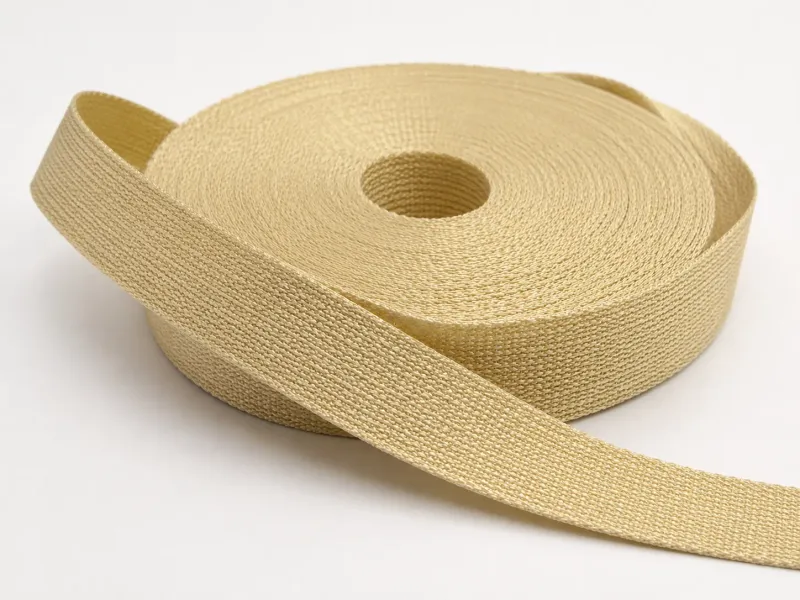
Flame Retardant Aramid Webbing
Flame-retardant aramid webbing designed for protective equipment and fire safety applications.
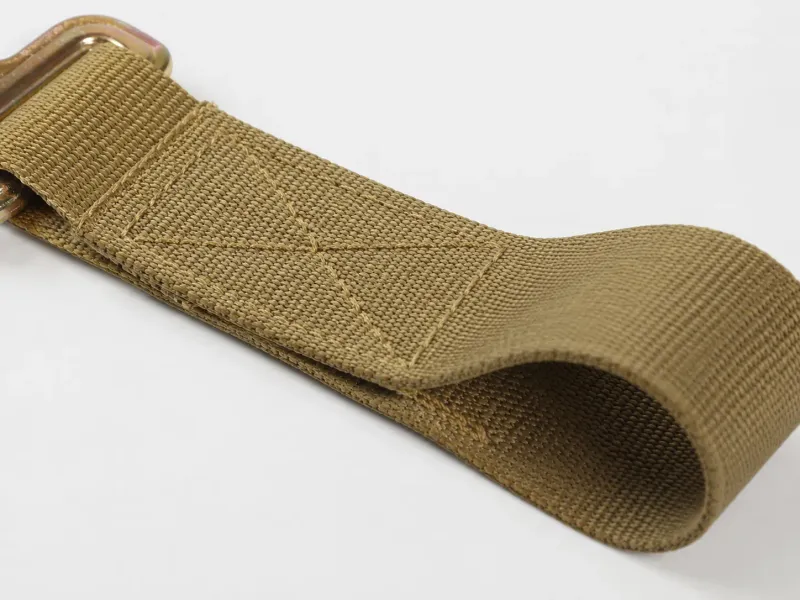
Aramid Safety Harness Webbing
Professional aramid webbing developed for high-temperature safety harness systems.
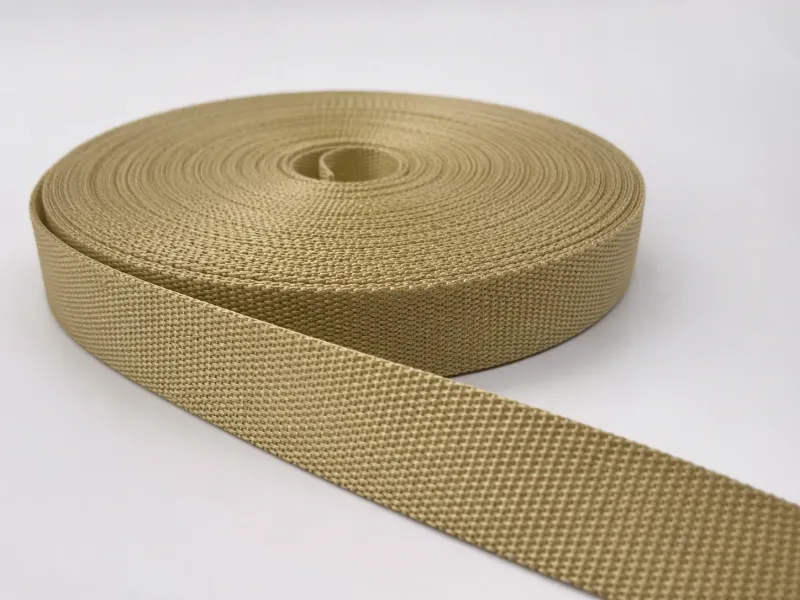
Industrial Aramid Webbing
Heavy-duty aramid webbing for industrial manufacturing, thermal protection and specialized equipment.
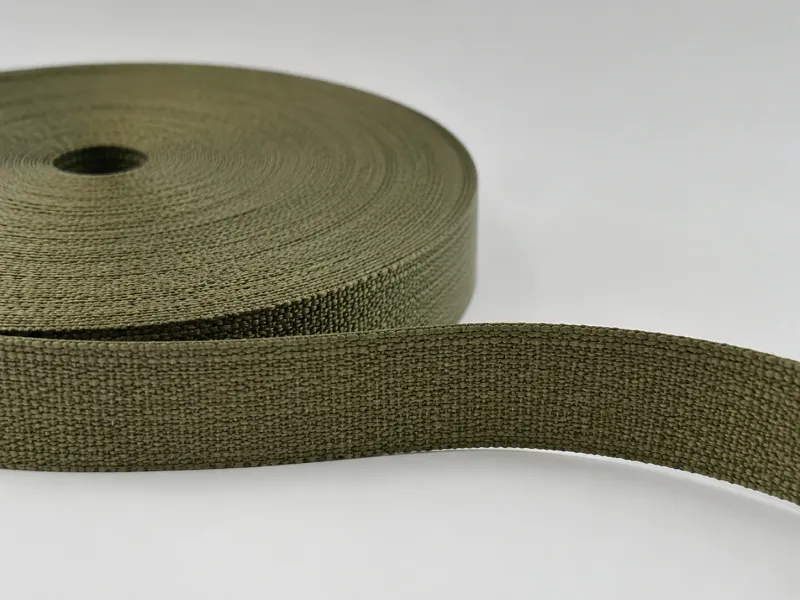
Military Aramid Webbing
Military-grade aramid webbing for tactical systems, load-bearing equipment and defense applications.
Related Applications
Related Industries
Industrial-grade aramid webbing belts engineered for extreme heat, flame exposure, and demanding safety-critical environments
Request a Bulk Quote for Certified Aramid Webbing